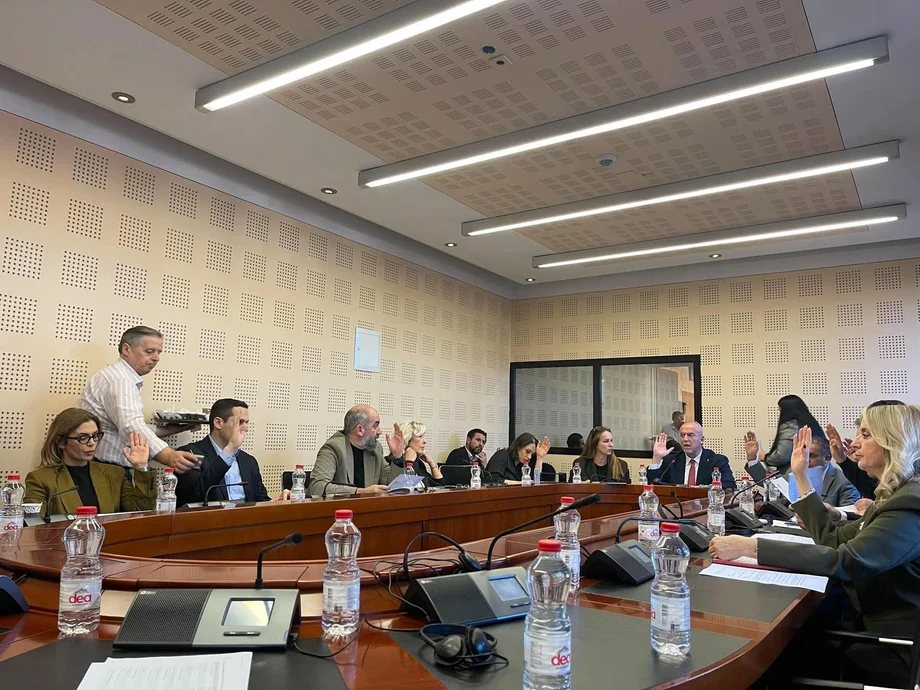
Committee approves report on the Draft Law on the Academy of Justice; Gruda’s amendment fails
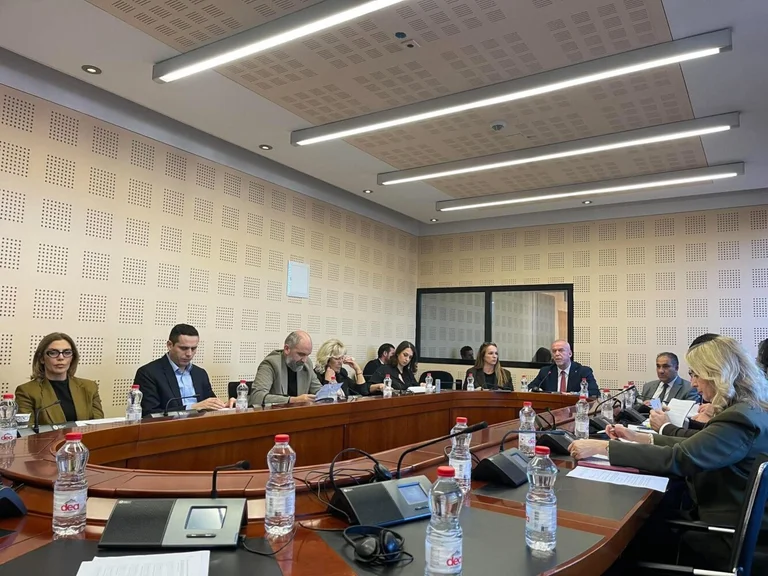
The Committee on Legislation, Mandates, Immunities, the Rules of Procedure of the Assembly and Oversight of the Agency for the Prevention of Corruption has approved the report with amendments on the Draft Law on the Academy of Justice, while an amendment by PDK MP Përparim Gruda concerning the composition of the institution’s Governing Council did not receive the necessary support.
During the review of the report, committee members discussed mainly the inclusion of the minister in the Academy’s Governing Council, an issue on which different views were expressed.
LDK committee member Doarsa Kica-Xhelili presented her concerns on the issue, saying that the main disagreement had to do with the concept of the independence of the Academy of Justice.
“Some of the more superficial concerns were accepted, while others, as in other cases, were not, but the main issue that remained unresolved was the removal of the Minister of Justice from the Governing Council. Let me tell you that here we are not just talking about a difference over the number of members; here, that is to say, we have two different concepts of the Academy’s independence and of how we interpret the Academy’s independence. One removes the minister and replaces him either with a representative of the minister who is not a political appointee, but can be delegated by the Minister of Justice, provided that he is not a political appointee; the other interpretation does not consider the Academy of Justice politicized if the minister remains. The sponsor’s repeated argument has been that in the past the representative of the Ministry of Justice was somehow not given sufficient consideration, and therefore the level of representation should be raised to the minister. The discussion was that it cannot be enough for a, let us say, feeling on the part of a representative of the Ministry of Justice about whether recommendations are heeded or ignored to be used to raise the level of representation to the political level. So, we can discuss whom the Ministry of Justice might delegate to represent it, but the minister himself should not go, because after all, this is an independent body. And we concluded that although the Academy is not an independent agency under the Constitution, there is nevertheless a possibility that this provision may be unconstitutional, while we interpret another aspect of this body’s independence in the spirit of the Constitution of the Republic of Kosovo,” she said.
“I was given an opportunity to speak again with representatives of the Ministry of Justice. Let me inform you that I met with one of them; a proposal was made, but two days later the proposal was withdrawn. Consequently, we are where we are, and the sponsor refuses to remove the minister from the Governing Council. So this will remain the main issue of concern for the working group; I have nothing else to add,” Kica-Xhelili stated.
Meanwhile, Vetëvendosje Movement committee member Adnan Rrustemi said that representatives of the Ministry of Justice had been willing to consider different options for the composition of the Governing Council.
He also mentioned a compromise proposal under which a university professor appointed by the minister would be included in the Governing Council, while the minister’s representative would serve during the first two years.
“It is true that ministry representatives said they were willing to review different options. This solution was also discussed, whereby there would be a university professor selected through a different nomination procedure by the chambers and law faculties, with the ministry making the final decision. And it is true that the latest version came about as a kind of compromise: the composition would be as such, with a university professor appointed by the minister, while, under the transitional provisions, the minister’s representative would serve for the first two years. I’ll tell you one thing briefly, without going on at length. First, the Ministry of Justice has had a representative on the Governing Council of the Academy of Justice before as well, but that representative was at civil servant level; that is, the director of the Ministry of Justice’s Legal Department represented the Ministry of Justice, as has been the case up to now. Second, we are talking about a body such as the Governing Council, whose full composition should also be considered: it consists of representatives of the judiciary and representatives of the prosecution service, and a link with policymakers—in this particular case, let us say, the Ministry of Justice—through the minister himself or, in this case, the professor. We must also consider the scope of its powers and, above all, its function,” Rrustemi stated.
“Ultimately, the Academy of Justice is an institution whose purpose is to raise the professional standards of judges and prosecutors through a form of additional and continuing education outside general formal education. In my view, it is an extremely important mechanism, also considering one of the fundamental weaknesses of the justice system, which is professional competence. So there are arguments for and against here, but I just wanted to present them; they were one of the votes, one of the votes of a broad body with specific powers. That is to say, it is not that we do not think it constitutes, let us say, interference in the system, because ultimately it deals with an education program,” Rrustemi said.
On the other hand, PDK MP Përparim Gruda presented his amendment, through which he requested that the Minister of Justice not be part of the Governing Council of the Academy of Justice.
Gruda said that including the minister in such a body runs counter to the principles of independence and the recommendations of the Venice Commission.
“Under this law, the Academy becomes an independent agency. The minister sits on the board of the independent agency, on its board—on its Governing Council. That makes no sense. It is unconstitutional. Venice has also said that the minister cannot sit on the board of an agency, on the council, as it is called here, of an independent agency. I have submitted my amendment and justified it; I have cited the Venice Commission. And we are reading it again, if you will, what I have just submitted, what I wrote in the reasoning. That is to say, Venice said: this is an independent agency, you have done very well to remove it from political power, but once you remove it from political power, you cannot then put the minister there to run it. You can put a civil servant there; a civil servant is not political. But if you appoint a cabinet member, a minister, or even the minister’s appointee—make no mistake—the professor is appointed by the minister; that is a political appointment, because the appointment is made by a political body. So I think we are moving into unconstitutional territory, contrary to what the Venice Commission has said. I don’t know why you are insisting; I think there is no reason to insist on having the minister there when you yourselves requested an opinion from Venice, Venice told you, and you did not respect it. That is the substance of the amendment I submitted,” Gruda stated.
Despite the concerns and objections raised during the meeting, PDK MP Përparim Gruda’s amendment was not approved, while the committee approved the report with amendments on the Draft Law on the Academy of Justice./eo