Netanyahu seeks full power, Ben Gvir and the left in the same government
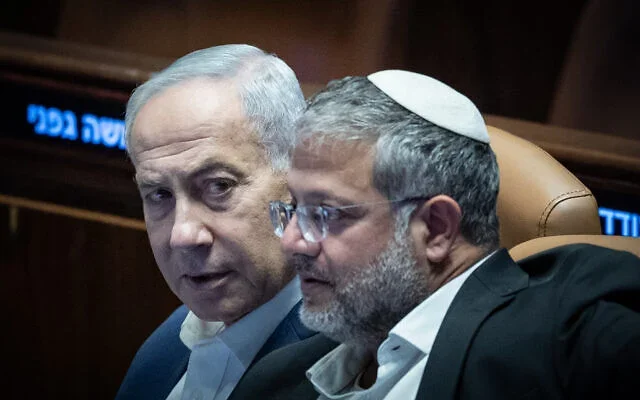
Benjamin Netanyahu is seeking to remain prime minister for the full four-year term in a possible unity government with the bloc led by Gadi Eisenkot, while the conditions put forward by Likud for negotiations have highlighted the major differences between the two sides.
According to reports by Israeli media, Likud’s demands were presented during a meeting between party representatives and the Yashar delegation, led by Eisenkot, through Michael Rabello, Netanyahu’s former personal lawyer.
Among the conditions presented is that Netanyahu not share the post of prime minister through a rotation agreement with Eisenkot, but retain it for the entire term. Likud also demands that all parties be included in the next government, from National Security Minister Itamar Ben Gvir’s Otzma Yehudit to the left-wing Democrats, with the exception of the two Arab parties.
According to reports, the next coalition would have to support a new offensive against Iran, oppose the establishment of a Palestinian state, and sign a declaration recognizing Israel as the nation-state of the Jewish people. Likud also demands that the judicial reform laws remain in force until a consensus is reached, and that the conditions of Hamas prisoners not be changed, despite allegations of human rights violations.
Netanyahu’s party is also calling for the establishment of a political commission of inquiry into Hamas’s October 7, 2023 attack, instead of a state commission of inquiry, as well as the advancement of a bill on the conscription of ultra-Orthodox Jews, based on the current government’s proposal. Other demands include that the Israeli army not withdraw from its current positions in Gaza until the threat from Hamas has been eliminated.
Sources from Eisenkot’s bloc told Haaretz that Likud’s proposal is not seriously aimed at forming a unity government, describing it as a propaganda effort by Netanyahu. Meanwhile, Likud has denied three of the claims concerning the commission of inquiry, judicial reform and conscription, without commenting on the other demands.
Eisenkot, who has been tasked with forming the government, previously ruled out the possibility of joining a coalition led by Netanyahu, but expressed willingness to form a unity government with Likud in which he would be prime minister. His bloc aims to bring together the four Jewish parties opposed to Netanyahu: Yashar, B’Yachad, the Democrats and Yisrael Beytenu.
However, Yisrael Beytenu leader Avigdor Liberman opposes a minority government that would rely on the Arab parties Ra’am and the Joint List, warning that this would pave the way for Netanyahu’s return with even greater electoral support. Liberman has proposed that Eisenkot’s bloc join the ultra-Orthodox parties Shas and United Torah Judaism to secure the minimum majority of 61 members in the Knesset, the Israeli parliament, which has a total of 120 seats.
Liberman has said he is confident that negotiations can be concluded quickly and that there are opportunities to form a government with the ultra-Orthodox parties, although he acknowledged that he has not held talks with them. He also opposes any unity government with Netanyahu, even if the latter were to serve as the second prime minister under a rotation agreement.
In his position, Liberman has stressed that the main objective is to end Netanyahu’s era in Israeli politics, insisting that he can be removed from power only through a right-wing bloc, not through the left.