Injured party asks Appeals Court to sentence Miloš Plesković to life imprisonment; defense says the accused was in prison at the time of the killings
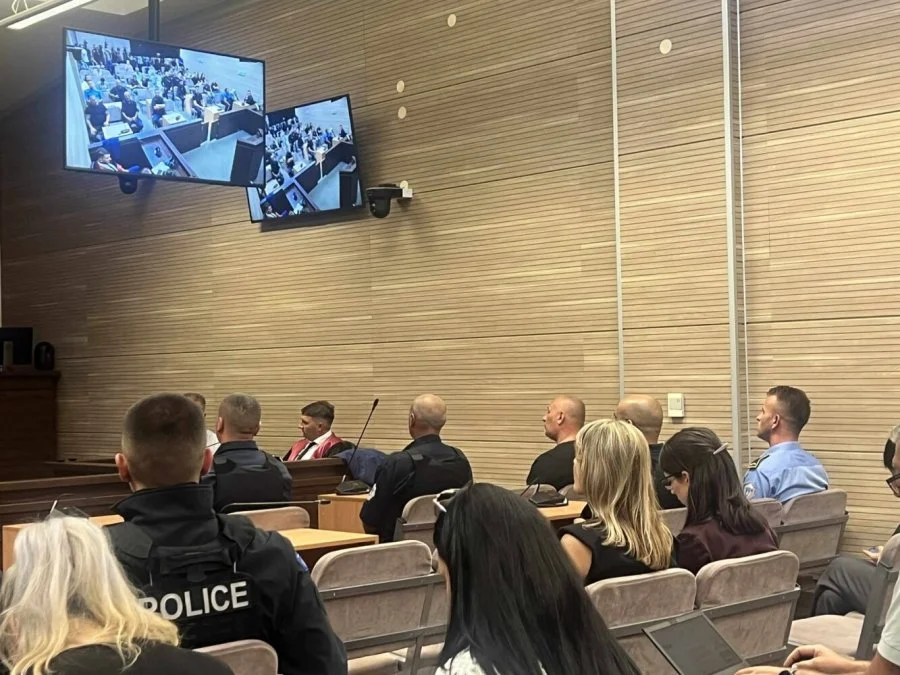
At the Court of Appeals on Monday, during the presentation of the defense’s appeal against the decision of the Basic Court in Pristina, which sentenced Miloš Plesković to 15 years in prison for war crimes in Prizren, the injured party requested life imprisonment. Meanwhile, the accused’s lawyer, Jovana Filipović, said that […]
At the Court of Appeals on Monday, during the presentation of the defense’s appeal against the decision of the Basic Court in Pristina, which sentenced Miloš Plesković to 15 years in prison for war crimes in Prizren, the injured party requested life imprisonment. Meanwhile, the accused’s lawyer, Jovana Filipović, said that at the time the killings for which Plesković is charged allegedly took place, he was in prison.
According to the indictment, during 1998–99 in Prizren, Plesković, acting jointly with a group of armed Serbs, killed three Albanian civilians and wounded several others, reports “Betimi për Drejtësi”.
First, the reporting judge, Albina Shabani-Rama, announced that the lawyer Filipović had filed an appeal against the Basic Court’s decision.
Shabani-Rama said that the injured party, the Special Prosecution and the Court of Appeals Prosecution had filed responses to the appeal, proposing that the Basic Court’s decision be upheld.
The injured party’s representative, lawyer Gent Gjini, said that the Basic Court had correctly established the decisive facts, but that the accused should be given the maximum sentence of 20 years in prison.
The injured party herself, Mihrije Daçaj, said that her twin sons had been killed and that 15 years in prison was too little. She requested life imprisonment.
“My two sons were killed; 15 years in prison is too little. It should be life,” Daçaj said.
Lawyer Filipović, for her part, raised objections to the Basic Court’s decision and said that the Prosecution’s investigation had been biased.
According to Filipović, the first-instance court did not gather the evidence that the defense had proposed be obtained. She added that at the time the acts were committed, Plesković was in prison and was not a police officer.
According to the lawyer, it had not been possible to establish the exact location where the criminal offense was committed, since the witnesses had mentioned a different location, the indictment another location, and the Court’s decision yet another location for the commission of the criminal offense.
Regarding the anonymous witness, Filipović said that they had not had access to the witness’s statement, which prevented them from mounting an effective defense.
During the presentation of the appeal by the accused Plesković’s lawyer, Jovana Filipović, the injured party, Bashkim Kastrati, reacted, addressing her in Serbian.
However, the presiding judge of the Appeals panel, Judge Mentor Bajraktari, warned him and asked the injured party not to repeat this action.
At the end, Judge Bajraktari said that the parties would receive the decision within a reasonable time.
On July 31, 2025, the Basic Court in Pristina sentenced Miloš Plesković to 15 years in prison for war crimes in Kosovo.
According to the indictment filed by the Special Prosecution on June 7, 2024, during 1998–99 in Prizren, Miloš Plesković, acting jointly with other persons, violated the rules of international law against civilians by killing the victims.
According to the indictment, Plesković, acting as part of an armed group of 7–8 people of Serbian nationality, was seen among the group on September 1, 1998, in Prizren, when the victims R.D., B.D. and F.B., together with the injured parties Fevzi Cana, Xhenger Cana and Bashkim Kastrati, were on their way to their mountain and were suddenly stopped by the armed Serbian group, who then insulted them in Serbian.
At one point, according to the indictment, Plesković began firing a “Kalashnikov”-type weapon, and the gunfire killed R.D., B.D. and F.B. at the scene, while the injured parties Xhenger Cana, Fevzi Cana and Bashkim Kastrati survived.
Furthermore, the indictment states that the relatives of the deceased were allowed to retrieve their bodies one week after the killings. It says that the bodies of R. and B.D. had been placed on top of one another, one of them had a severed leg, while victim F. was missing his head.
Therefore, for these acts Plesković was charged with the criminal offense of “War crimes against the civilian population,” sanctioned under Article 142 in conjunction with Article 22 of the Criminal Code of the former Socialist Federal Republic of Yugoslavia, the law in force at the time the criminal offense was committed. /BetimipërDrejtësi