
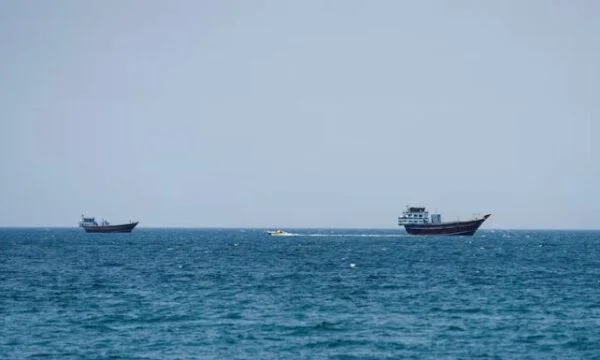
Iranian attacks have not stopped oil exports, but refineries are struggling
Crude oil exports from the Middle East reached their highest level since the start of the war with Iran in September. Shipping and energy-market data show that supplies have increased despite Iranian attacks on vessels in the Strait of Hormuz. However, the rise in exports has not solved the problem […]
Crude oil exports from the Middle East reached their highest level since the start of the war with Iran in September.
Shipping and energy-market data show that supplies have increased despite Iranian attacks on vessels in the Strait of Hormuz.
However, the rise in exports has not solved the problem of supplies of refined products.
Limited refinery capacity continues to put pressure on the market and has driven diesel prices up worldwide.
European Union data published on October 1 show that the price of diesel at the pump has reached a record high.
Prices have also risen sharply in the United States, despite the recovery in oil exports.
“More oil is being exported from the Middle East Gulf than expected. Just a few months ago, many people thought such a level of exports would not be possible,” Richard Meade, editor-in-chief of Lloyd’s List, said during an online conference on October 1.
Oil exports recover
Lloyd’s List data show that the number of crude oil tankers passing through the Strait of Hormuz has risen steadily since mid-July.
This followed a major drop in traffic after the memorandum of understanding between the United States and Iran, which aimed to end the conflict now in its eighth month, fell through.
Investment bank JPMorgan estimated that Middle Eastern crude oil exports reached 98 percent of prewar levels in September, describing this as “an extraordinary recovery for a region that remains at war.”
Commodity-market analytics firm Kpler reported that Saudi oil exports were at the 2025 average level.
Meanwhile, maritime intelligence company Windward said that four times as much oil was loaded at Saudi terminals as in August.
Despite this major increase, the volume was still nearly 40 percent lower than in January.
Several factors appear to have contributed to the recovery in exports: Saudi Arabia’s East-West Pipeline, transporting oil by intermediary vessels and transferring it from one ship to another, as well as the willingness of some companies to take on greater risk.
The Saudi pipeline transports crude oil to the port of Yanbu on the Red Sea, thereby avoiding the Strait of Hormuz.
It was damaged on September 10 in an attack by Iran-backed Houthi militants.
However, the increase in shipments from Yanbu later in the month indicated that the pipeline had regained at least some of its lost capacity.
The United Arab Emirates has also found a similar route, using its pipeline to the port of Fujairah, in the Gulf of Oman.
This pipeline has also been targeted by Iranian attacks, but the route is much less vulnerable than the one through the Strait of Hormuz.
Another way of getting oil to market is to use smaller vessels to transport it through the Strait of Hormuz, sailing close to the coast of Oman—in a corridor patrolled by the U.S. Navy.
These vessels, which often travel in groups, then transfer the oil to larger tankers in the safer waters of the Gulf of Oman.
Meanwhile, refineries in India have also reportedly begun chartering tankers to travel this route directly.
Attacks continue
The risk to maritime transport, however, has not disappeared.
In the latest incident, on September 30, three Liberian-flagged tankers were struck by unidentified projectiles as they passed through the Strait of Hormuz.
Industry analysts estimate that companies have now factored this risk into their operating costs.
“The increase in exports does not necessarily mean that the Strait of Hormuz has become safe. It simply shows that the oil industry has learned to operate by adapting to this risk,” Meade said.
Crude oil prices have fallen from recent highs, but problems with refinery capacity continue to be felt around the world.
According to the International Energy Agency (IEA), much of the problem is concentrated in the Persian Gulf.
Iranian attacks on refineries, together with disruptions to transport through the Strait of Hormuz, have led to a significant drop in refined-product output, according to the IEA.
“In 2025, Middle Eastern producers were exporting 3.3 million barrels of refined oil products per day. But since the start of the conflict, up to 3 million barrels of daily capacity have been offline,” the IEA wrote in an analysis published on September 21.
The global diesel shortage has also been exacerbated by Ukrainian attacks on Russian oil refineries, which have prompted the Kremlin to ban diesel exports.
“Refineries around the world are already operating at the limits of their capacity,” the IEA said.
“This leaves little room to prevent further tightening of supplies and rising prices in the coming months,” the agency said.














