
Kosovo in Serbia’s Election Campaign
Beyond the constant manipulation in the service of those in power, whenever Serbia faces internal crises, and especially during election campaigns, Kosovo returns forcefully to the center of its nationalist rhetoric. It is used as a symbol of the strategy of “victimization,” as a spur to mobilize the electorate, and as an instrument for revisionist policy related to “historical injustice,” […]
Beyond the constant manipulation in the service of those in power, whenever Serbia faces internal crises, and especially during election campaigns, Kosovo returns forcefully to the center of its nationalist rhetoric. It is used as a symbol of the strategy of “victimization,” as a spur to mobilize the electorate, and as an instrument for revisionist policy related to “historical injustice,” which must be corrected.
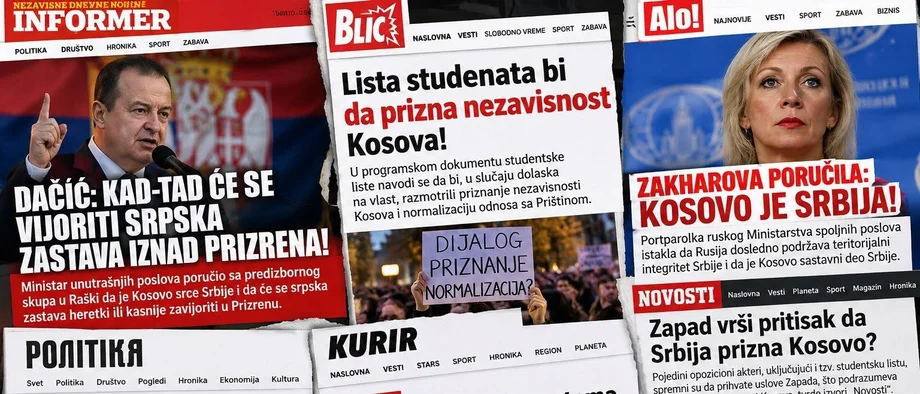
The statement by the Minister of the Interior and leader of the Socialist Party of Serbia, Ivica Dačić, that “sooner or later the Serbian flag will fly over Prizren”, exposes Serbia’s threatening and destabilizing approach toward Kosovo. Made during an election rally in Raška, it was not simply an expression of nostalgia, but a rejection of recognition of reality (with Kosovo independent) and a warning of the continuation of the hybrid strategy against its stability and international consolidation (Danas, 07/10/2026).
In a region that continues to face the consequences of the wars of the 1990s, such a statement cannot be treated simply as election rhetoric, because it is provocative and threatens with the aim of restoring Serbian control. Thus, it exposes Serbia’s “constructiveness” in the EU-mediated dialogue, manifesting its true aims in the “normalization” process. For this reason, nationalist rhetoric centered on Kosovo is the political model that must be treated as a risk to regional peace and security, as sabotage of the normalization process, and as a threat to the EU’s credibility.
“Forms” of Kosovo in election rhetoric
Dačić’s threat of the Serbian flag over Prizren; Vučić’s accusations that the Student List “will recognize Kosovo and impose sanctions on Russia” (Vreme, 11.10.2026); support for “United Serbia” from the Slovak prime minister, who promised at a rally for this political entity that “he would never let them down regarding Kosovo” (Klix.ba, 16.10.2026); Russian support from Maria Zakharova with the slogan “Kosovo is Serbia” (Politika, 16.10.2026); the projection of an “enemy” by Petar Petković, with Albin Kurti cast as a supporter of the Student List (Nin, 09.10.2026); claims by opposition figures Jovanović and Gajić about “the return of Kosovo” (N1, 10.10.2026); as well as the separate but similarly motivated support of the Serb List and the Serbian opposition in Kosovo (RFE, 24.09.2026)—these are some of the identified forms of instrumentalizing Kosovo as a common denominator in the race for Serbia’s October 25 elections.
These not only shape the future government’s shared position toward Kosovo, but also the continuation of its geopolitical alignment with Russia. The students’ response regarding sanctions against Russia not only confirms this, but also shows that they project “defending” Kosovo through Moscow (Masina.rs, 30.09.2026).
Aleksandar Vučić remains the leader of this rhetoric, repeating that “he will never recognize Kosovo” (Tanjug, 14/10/2026), despite the fact that this challenges the dialogue and holds Serbia hostage to a destabilizing policy (Hehir, 2025:15). Rivalry with him does not mean distancing oneself from the nationalism that has dominated Serbian politics for decades (Vulović, 2023:530), because a part of the opposition and the Student List also rely on the same narratives about Kosovo, observes Boris Varga of the Center for Western Balkans Studies (Varga, 2026).
Therefore, Kosovo is once again proving to be a determining factor in these elections, overshadowing issues of real interest to citizens in Serbia, while Russia, for its part, has been invited to observe them, manifesting its conception of itself as a legitimizing factor. Foreign Ministry spokeswoman Zakharova confirmed that they would send representatives from both chambers of parliament, from the Central Election Commission, and observers as part of the OSCE/ODIHR mission (RT Balkan, 21.10.2026).
The consensus holding “normalization” hostage
The lack of accountability for the terrorist attack in Banjska (2023), involvement in the attack on the Ibër-Lepenc canal (2024), continued rapprochement with Russia, and the intensification of an aggressive stance toward Kosovo in domestic and international rhetoric inevitably affect the Brussels-mediated normalization process (European Commission, 2025:65).
The European Union cannot limit itself to calls for restraint, calm, and continuation of the dialogue while threatening statements by Serbian politicians about the “flag over Prizren” continue. The dialogue cannot succeed by sanctioning Kosovo for its lawful actions and “rewarding” Serbia, despite its strategic divergence from EU foreign policy. The success and credibility of the mediator depend on applying the same standards to both parties and making Serbia’s fulfillment and implementation of the obligations it has undertaken a condition (Pavković et al., 2026).
Without accountability, calls for dialogue remain mere statements, while the absence of political consequences for Serbia calls the seriousness of international engagement into question. If the EU aims to play a credible mediating role, it must make clear what it expects from Kosovo, what it expects from Serbia, which violations have been documented, and what the consequences will be in the event of non-compliance (Stepaniuk, 2023:94-95).
Because the current campaign for the October 25 parliamentary elections showed that part of the opposition and the Student List take an even more hardline nationalist approach. This was also noted by journalists Iva Martinović and Dušan Komarčević in the article “What message are student protesters in Serbia sending with the ‘Memorandum’ on Kosovo?”, published by Radio Free Europe on May 19 of this year (Martinović &Komarčević, 2026).
This means that the message for Kosovo remains clear: Vučić’s removal from power is not enough as long as the other side’s political ideas are the same. An opposition that refers to Kosovo as a “territorial grab” and a student list that considers it “part of Serbia,” while rejecting sanctions against Russia (CFWBS, 02/10/2026), cannot be the alternative for “normalization,” nor the heralded change for a democratic Serbia.














