When Peaceful Protest Fails, Is Violence Justified?
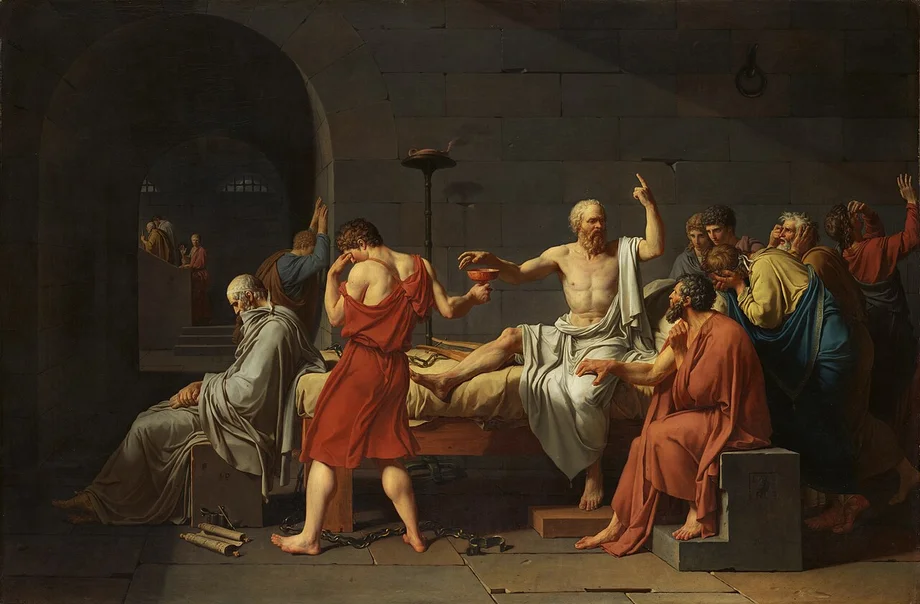
One of the major philosophical questions raised by the high school students’ protest movement is this: to what extent can violence be considered legitimate, whether exercised by students or by the police? To answer this question, Nicolas Tenaillon has imagined a dialogue between Socrates and a high school student. And this time, it is the philosopher who seems bewildered by his interlocutor!
One of the major philosophical questions raised by the high school students’ protest movement is this: to what extent can violence be considered legitimate, whether exercised by students or by the police? To answer this question, Nicolas Tenaillon has imagined a dialogue between Socrates and a high school student. And this time, it is the philosopher who seems bewildered by his interlocutor!
Cynthia: Socrates, you say it is better to suffer injustice than to commit it. But is it unjust to use violence when you think you are being treated unjustly because nobody listens to you? Honestly, when adults impose their decisions on us without paying attention to our demands, should we keep obeying them meekly?
Socrates: You raise a good question, Cynthia. But do you think that the fact that you are not being heard gives you and your high school friends the right to use violence against others?
Cynthia: Not necessarily. But when all other solutions fail, are we left with any alternative? If we protest peacefully, as Gandhi did, but nothing changes, what else can we do but turn to violence? Isn’t this the only path that gets results?
Socrates: So it seems you think that the effectiveness of an action is enough to make it legitimate. But wouldn’t that mean that an action, whatever it may be, is right as long as it helps us achieve what we want? If we accepted that, then justice would depend on force, wouldn’t it?
Cynthia: No, I’m not saying that every use of force is legitimate. I’m saying it can be justified when it is used in response to an injustice that has become unbearable. If students feel forgotten and humiliated, on what basis of justice can they be forbidden to rebel?
Socrates: To answer your question, I think we should first examine what you mean by violence and justice. Otherwise, we risk confusing legitimate resistance with revenge. For me, justice means acting in accordance with the Good, while violence means forcing another person to do something against their will, through force.
Cynthia: In the few classes we’ve had since September, our philosophy teacher taught us that, according to the sociologist Max Weber, only the state can successfully claim a monopoly on legitimate violence. Well, we disagree with Weber. When some subjects go without teachers for months, when timetables are overloaded and absurd, and school buildings are at risk of collapsing, preventing lessons from continuing by blocking the school and setting fire to dumpsters is, for us, a legitimate form of violence, not revenge.
Socrates: But when you throw stones at the police, who are responsible for keeping the peace in the city, doesn’t that become illegitimate violence?
Cynthia: Perhaps. Although one student in our class, an intellectual type who reads all the time, would answer you with a counterargument I really liked.
Socrates: What is it?
Cynthia: He got it from a certain Walter Benjamin, from an old book published in 1921 called Critique of Violence. According to this German author, the police tend not to distinguish between the violence that establishes law, as in the French Revolution, and the violence that preserves it. So, even though the police are instructed to respond proportionately to provocations by high school students, according to this argument, the risk of abuse is inherent in their very nature. Their excesses are ongoing and can be seen everywhere. That is precisely what undermines the law in whose name the police act and makes our violent response legitimate.
Socrates: Interesting. I admit that authority, when it commands respect, does not need to display its power through violence. A great philosopher, Hannah Arendt, expressed this idea very well. But doesn’t the counterviolence you are talking about harm others—those who do not want to get involved in the conflict between you and the representatives of the state, namely, educational institutions and the police?
Cynthia: Who do you mean?
Socrates: The students who want to continue their studies. School blockades affect them severely because they prevent them from continuing their education normally. If they want to take exams, don’t they also have the right to oppose the blockade?
Cynthia: Yes, of course. Their freedom matters too.
Socrates: Then which freedom should prevail: yours or theirs?
Cynthia: The students involved should be able to discuss this issue together…
Socrates: Of course. But let us suppose that in this discussion the majority supports continuing the blockade. Is the fact that they are more numerous enough to make them right?
Cynthia: No, of course not. The majority can be wrong too.
Socrates: Exactly. I would have argued against this with Protagoras too, that renowned sophist who thought that a “powerful discourse,” one that persuades the majority, should determine what is just. I, on the contrary, insist that for an action to be just, it must be based on reasoning and not on an opinion that manages to persuade the greatest number of people. Reason tells us that when we fight against an injustice, we must not let that struggle create an even greater injustice than the one we are trying to fight. So, ultimately, it is better to suffer injustice than to commit it.
Cynthia: But, Socrates, it seems you think that preventing students who want to continue their studies from doing so is more serious than fighting those who prevent us from having decent conditions in which to study. Don’t you think the greater injustice is the one inflicted on us by the institution, rather than the one we inflict on students who put their personal success at school above everything else? For us, it is precisely their obedience to the system that is unjust.
Socrates: Good argument. I admit that respecting order does not always mean respecting justice. But you should also admit that breaking the rules is not necessarily proof of courage.
Cynthia: For those who have been scorned and felt insulted by the educational institution, I think that taking part in protests and openly expressing their suffering is, on the contrary, a form of courage.
Socrates: But the fact that someone has suffered does not mean that they are always right. They may be mistaken in their judgment, react disproportionately and, in the end, become unjust themselves.
Cynthia: By reasoning this way, Socrates, you side with the person in power, because you demand that those who suffer restrain themselves and always act rationally, while respecting the rules that others use against them.
Socrates: But should we then say that someone who suffers injustice must abandon every moral principle in order to restore justice?
Cynthia: No. But we have the right to disobey unjust rules that undermine students’ dignity.
Socrates: It is true that authority alone is not enough to make rules legitimate. But if everyone decides to obey only the rules they consider just, what will happen to our shared life?
Cynthia: Agreed, there is a risk of anarchy here. But is it better to promote a society in which nobody can challenge authority?
Socrates: No, because such a society would be tyrannical. Nevertheless, if we give opposition too much room, we risk replacing dialogue with a mere clash of forces. Do not think that an act of opposition becomes more just simply because it is collective. A crowd can easily be carried away by anger and seek revenge against a culprit it invents itself, without necessarily relying on facts. In his work The Psychology of Peoples and Crowds, Gustave Le Bon showed how easily a crowd can regress in its development and how incapable it can become of dialogue.
Cynthia: Perhaps a crowd is not always right, but its indignation deserves to be heard, doesn’t it?
Socrates: Yes. That is precisely why those in power should not place the maintenance of order through force above the pursuit of justice through dialogue and agreement.
Silence.
Cynthia: You seem lost in thought, Socrates…
Socrates: The more I think about this issue, the more convinced I am that the problem we need to solve, if possible, is that of the legitimacy of civil disobedience.
Cynthia: What do you mean by that?
Socrates: I’m wondering to what extent we can justify it and ground it in rational principles.
Cynthia: What do you think?
Socrates: If I trust what has been written on this subject, I think that opposing the state, as Henry David Thoreau did when he refused to pay taxes because at the time they were used to finance the war against Mexico with the aim of annexing Texas, risks confusing morality with politics. It is clear that civil disobedience must have an impact on the life of the city and society; otherwise, it remains merely a symbolic stance.
Cynthia: You see, Socrates? You’re talking about effectiveness too.
Socrates: Yes, but what worries me most is that the pursuit of effectiveness can lead to civil war. We Greeks call this stasis (the breakdown of harmony). It is the city’s gravest disease, because violence draws everyone in and turns a neighbor, friend or even relative into a potential enemy. If high school students blocking schools begin to use violence not only against the police but also against teachers or their classmates who want to continue their studies, and even against parents trying to stop them from protesting in order to protect them from police violence, then the danger becomes great. The cause they are defending may not only fail, but also lose its legitimacy because of the uncontrollable chaos it causes.
Cynthia: We haven’t reached that point. It isn’t high school students who are calling for an uprising.
Socrates: May the gods of Olympus hear your words! I believe, as does Hannah Arendt, whom I mentioned earlier, that we must have faith in the laws of the city. Civil disobedience can be legitimate only if it does not undermine the fundamental laws of the political system that has made education accessible to everyone.
Cynthia: But is there any rule that can limit high school students’ violence, so that they can achieve their goals without engulfing the whole city in fire and blood?
Socrates: Let me refer to one last thinker to answer this question: the American John Rawls, author of A Theory of Justice. Although he does not consider disobedience a way of legitimizing violence, he says it can be justified only if three conditions are met.
First, there must be serious violations of the fundamental principles that make a society just.
Second, all legal means must have failed in order to make the demands acceptable, either because those in power lack goodwill or because society is apathetic.
Third, disobedience must not be accompanied by a large number of similar actions, because this would cause too much disorder.
You see that the present situation meets the first two conditions. But to be legitimate, the high school students’ violence must also respect the third condition. This means they must resist the temptation to bring all grievances and struggles together in a single protest that could erupt into general anger.
Cynthia: Because, in that case, their cause would lose its distinctiveness within a general opposition to the city and contribute to its destruction through what you call stasis?
Socrates: You have understood me well, Cynthia.
Text published in the magazine Philosophie, translated and adapted for Dukagjini.