
Serbian Deception with Trump’s Consultants
In a region where states and political actors openly work to undermine its orientation and security architecture, lobbying contracts—and especially consultancy from figures linked to President Trump—are strategic elements exploited for hybrid influence operations. The engagement of Chris LaCivita and James Blair in the service of the Republika Srpska of Bosnia and Herzegovina has […]
In a region where states and political actors openly work to undermine its orientation and security architecture, lobbying contracts—and especially consultancy from figures linked to President Trump—are strategic elements exploited for hybrid influence operations.
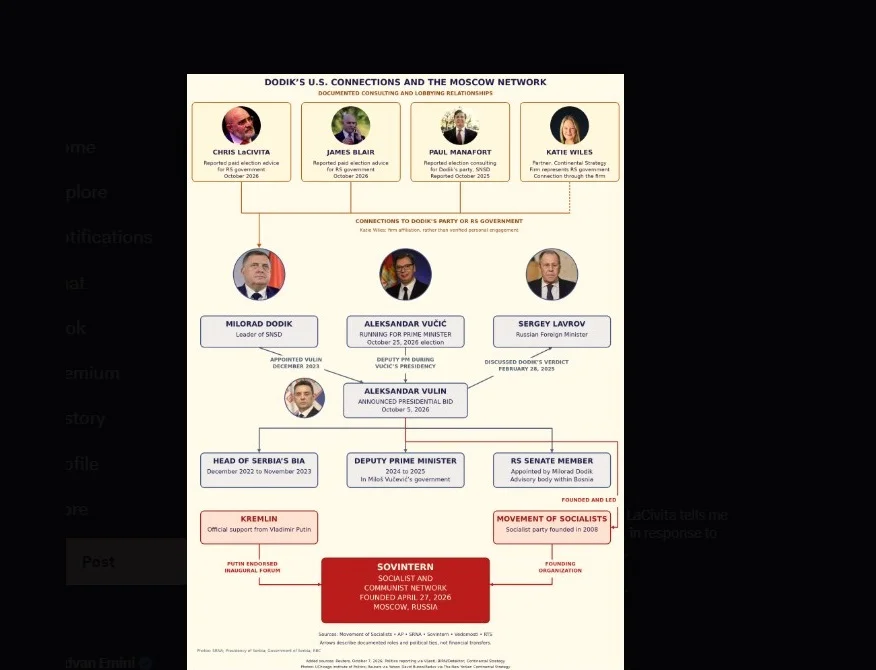
The engagement of Chris LaCivita and James Blair in the service of the Republika Srpska of Bosnia and Herzegovina has raised concerns about possible influence on U.S. policy toward the Western Balkans. President Trump has said they are outside advisers and that he “has not seen a conflict of interest” (Reuters, 07.10.2026), but Albanian-American activist Evi Kokalari has made allegations that their engagement is serving the destabilizing agenda of Russia and figures close to Putin (Dukagjini, 08.10.2026).
In a post on X, she presented them in a diagram as “Dodik’s ties in the U.S. and the Moscow network,” specifying Aleksandar Vulin, Aleksandar Vučić, and Sergei Lavrov. Although claims of a coordinated Russian operation remain to be verified, the debate has highlighted the reality of contracted consultancy being instrumentalized to create the impression of “support from the U.S. administration.”
The more ambiguity there is in the relationship between consultants’ private engagements and the official position of the United States of America, the greater the influence and manipulation of public perception, serving to normalize and legitimize the revisionist agenda of Serbia and Republika Srpska.
Thus, the issue should not be limited to whether or not a conflict of interest exists, but whether contracting can be used to manipulate and change the U.S. position on the Western Balkans. Promoting Dodik’s closeness to the U.S. serves not only to improve his international image, but also to advance a deceptive narrative according to which his political aims do not run counter to American interests.
For this reason, Kokalari began her response with a statement by a member of LaCivita’s team to journalist Kellie Meyer that “Republika Srpska supports conservatives and the ‘America First’ approach,” calling it a lie. Therefore, she continues, the ties of these figures to the socialist and communist SOVINTERN network, which she says was founded in Moscow in April 2026, contradict the values of American conservatives.
Whatever the truth may be, closeness to the U.S. in the Balkans is an important source of credibility, and this is precisely what explains the Serbian ploy of “legitimacy laundering.” Vučić used the same method at the UN General Assembly (23.09.2026), “accusing” President Clinton of “injustice” toward Serbia and flattering President Trump as the hope for “correcting” it.
Thus, “perpetual victimhood” is the Serbian platform that camouflages the hybrid operations of revisionist policy. At this point, it converges with Russian interests, seeking to weaken the Western orientation and structures of the Balkans and legitimize the expansionist project of the “Serbian World.”
Therefore, the engagement of American consultants by Republika Srpska merits particular attention in the analysis of hybrid threats.
AD PLACEHOLDER














