
TESTIMONY FROM CELL 725
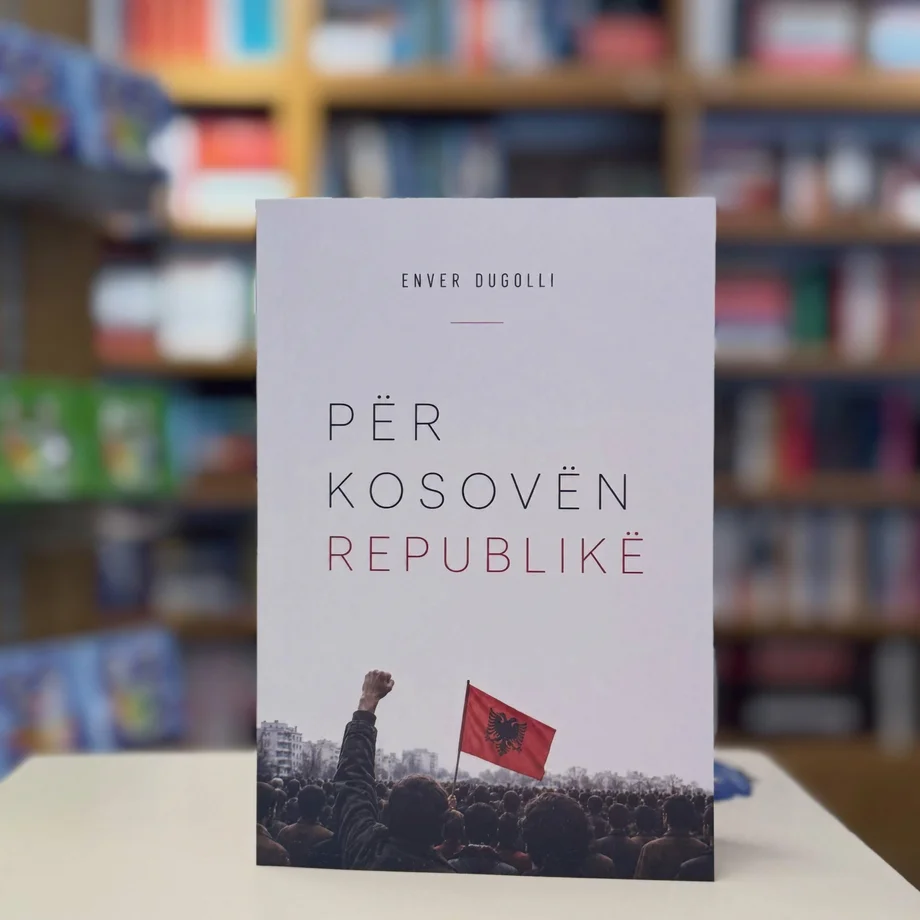
A review from a reader’s perspective The book “FOR A REPUBLIC OF KOSOVO,” by its author and main protagonist, Enver Dugolli, is a documentary work written in the first-person singular. Through the developments and events it describes, the book takes readers back around 45 years, immersing them in the thoughts and experiences of a […]
A review from a reader’s perspective
The book “FOR A REPUBLIC OF KOSOVO,” by its author and main protagonist, Enver Dugolli, is a documentary work written in the first-person singular. Through the developments and events it describes, the book takes readers back around 45 years, immersing them in the thoughts and experiences of an important period in our history.
Reading it makes you feel proud of the resistance and of the way members of the Albanian people stood up to Serbian repression and oppressive policies. More specifically, the book covers a period in the 1980s, when Kosovo Albanians had resumed organized activities for their rights, through people organized into numerous groups and cells, demanding a Republic of Kosovo.
Historical context
1981 was a period when, through concrete actions, an important part of Kosovo’s history began to be written. This part continued the earlier efforts of the people and their sons and daughters. The period from 1945 to 1966 must also be viewed in this context, and may be called the period of resistance following the National Liberation War.
Through their organized groups, Albanians had waged political and clandestine resistance for their country’s self-determination. These organizations included the “Revolutionary Movement for the Unification of Albanians” (LRBSH), led by Adem Demaçi; the group of young students associated with the LRBSH, including Selatin Novosella, Ibrahim Gashi, Shemsi Hoxha, Osman Dumoshi, Ali and Ilaz Pireva, etc., who later reorganized and became known as the “Demonstrations Committee”; the “Revolutionary Party for the Unification of Albanian Lands with the Motherland,” led by Metush Krasniqi; the “Organization for the Unification of Albanian Lands,” led by Remzi Baloku; the “Committee for the Unification of Kosovo with Albania,” led by Kadri Halimi, etc.
Thus, these efforts, alongside many other local initiatives that inspired the generations to come, were among the precursors to the mobilization of 1981. Naturally, in this context, the discriminatory, oppressive and systematic policies against Albanians in Kosovo cannot be overlooked.
As a result, the student demonstrations of 1981 marked a significant turning point. In this context, the demand for a Republic of Kosovo became one of the main political demands and an important step in the further development of national aspirations. At the time, the book’s author, Enver Dugolli, was only about 18 years old.
Arrest and confrontation
Since the book is documentary in nature, it contains a wealth of information about the author as a person: who he was, where he came from, what family he was born into, his financial circumstances, marital status, education, health, activities, etc. For this reason, there is no need to repeat this information in this review.
Enver was arrested at a very young age, just after leaving childhood behind. Perhaps he could even be called a “grown-up child.” The circumstances of his arrest are presented with extraordinary authenticity, as the saying goes, “firsthand.”
The way the author describes his emotional and spiritual bond with children is particularly interesting. A child, perhaps better than anyone else, feels the burden of captivity, because by nature a child wants to be free. For a child, freedom is natural and absolute. The author seems to have had a natural gift for connecting with people, especially friends, peers and younger children.
The ruling system was repressive and, consequently, so too were his arrest, the treatment he received and the violence inflicted on him. In the face of all this, his resistance was unbreakable. This is one of the parts that makes an impression and, in some cases, seems unbelievable to those who did not know the author or experience that time, especially considering his young age.
Life in prison
Life in prison is always difficult, regardless of the political system or whether you are in the state to which you belong. But when you are in a prison where you regard the system holding you captive as the enemy from whom you must free yourself, regardless of the consequences for your health or life, prison becomes one of life’s most difficult experiences.
Inside prison, in addition to material suffering, there is also an immense spiritual burden. In this case, the spiritual burden may be even heavier than the physical one.
The author particularly highlights his worries about his family. In his view, his family was suffering because their son had chosen a difficult path to be filled with dignity and pride, and he thought that the consequences of his stance would also weigh on his family.
Knowing what consequences could follow, his situation during pretrial detention and imprisonment was not easy. This placed the author in a double dilemma.
On the one hand was the conviction: “I did the right thing,” because the idea of contributing to the national cause was non-negotiable for him. On the other hand was the thought that he should apologize to his family for the consequences they were bearing because of his stance.
In fact, the latter was not quite the case. It had to do with the way repression extended to his family and their social and family ties. The suffering of his family, like that of many other Albanian families, was part of a repressive reality that could occur systematically: today, tomorrow, the day after, every day, month, year…
So he seemed to ask himself: “But if I hadn’t done this, would my family have suffered?”
In both of these dilemmas, Enver Dugolli takes on excessive responsibility, driven by his great love for his country and his strong emotional bond with his family. To him, concern for his family was largely equivalent to love for his country.
Resistance
The pressures and hardships of his time in prison are presented as extraordinary, but they never overcome his determination to maintain an unbreakable and dignified stance, morally and nationally.
Admitting what he had done and why; refusing to give up the names of his comrades; trying to defend his purpose in the face of a repressive machine—all of these are presented as stances of great human and political significance, while each brought with it grave consequences and unimaginable violence.
In his accounts of Gjilan prison, the author also describes a particularly shocking case: that of political prisoner Fatmir Salihu.
Fatmir was a heavy smoker. The way he rested his little finger on the glowing end of a cigarette, and the circumstances that had brought him to that point, provide extraordinary testimony to the extent of the physical and psychological pain experienced in prison.
To overcome the pain of beatings by inflicting another pain on yourself by burning your finger is something that defies imagination. He had done this to forget a great pain through another pain—to smother pain with pain.
This episode makes the reader reflect on the extent of the violence and suffering endured by Albanian political prisoners. The case seems to have been included in the account precisely to make known the sacrifices of this group of people and their resilience in the face of demands and convictions they considered just.
Another testament to the unwavering stance of the author and his fellow prisoners was their demand to be returned to the prisons in Kosovo. Here we see a painful paradox: they preferred prisons in their own country to prisons in Serbia.
Imagine a situation in which, among dreadful prisons, a person is forced to choose and ask for one of them. Their strong morale challenged even the violence inflicted on them. Resistance was measured by the ability to withstand the blows and pain inflicted on them.
This reminds me of the well-known line from the song about the KLA, sung by Ilir Shaqiri: “…there aren’t enough bullets for all of us…”
Another telling scene is when the prison guard tells Enver: “Eat your food, or I’ll beat you to a pulp.”
In this scene, Enver is depicted as utterly exhausted and, for a moment, thinks of taking the food to preserve at least some of his health. Nevertheless, as he continues the hunger strike that the prisoners were holding to be returned to Kosovo, he again refuses the food, also in response to the threat the guard had perhaps made inadvertently.
He says: “I won’t take it. He thinks I’m afraid of him!”
This scene shows that their purpose and stance took precedence over every challenge, whether it concerned their health or even their lives.
The documentary value of the book
Enver Dugolli’s book “FOR A REPUBLIC OF KOSOVO” does not present only isolated episodes from the life of a political prisoner confronting a repressive communist system and oppressive policies against Kosovo Albanians.
The book itself contains testimony about a period of captivity that remains part of the history of the suffering of Kosovo Albanians and their efforts for rights and self-determination.
It is the testimony of a man who experienced suffering firsthand. It is a testament to resistance, strong moral character and devotion to the homeland. It shows that the path of confronting captivity and injustice is not determined by youthful desires or longing for one’s family.
This book depicts the determination to persevere to the point of self-sacrifice, if circumstances demanded it. It presents not only Enver Dugolli’s personal story, but also testimony to an important historical period.
For this very reason, the book has multidimensional documentary value: it weaves together personal memory, the experience of prison, political history and collective memory.
The book’s message
The personal memories the author conveys in this book are an important part of the historical memory of Kosovo Albanians about the period around 45 years ago.
The book’s significance also lies in its testimony to the suffering of Albanians in that period. For readers, it remains a testament to sacrifice, resistance and devotion to the homeland.
Historical memory refreshes and keeps alive the collective memory of a people. Therefore, reading a book like this should not remain merely an individual experience. It should also serve as an incentive to learn more about the writings, testimonies and works that portray the journey, suffering and sacrifice for a Republic of Kosovo.
In this sense, “FOR A REPUBLIC OF KOSOVO” is more than a personal memoir. It is testimony drawn from firsthand experience of prison, an account of resistance and part of the memory of a generation that lived through a difficult period in Kosovo’s history.
Ilir Dugolli














