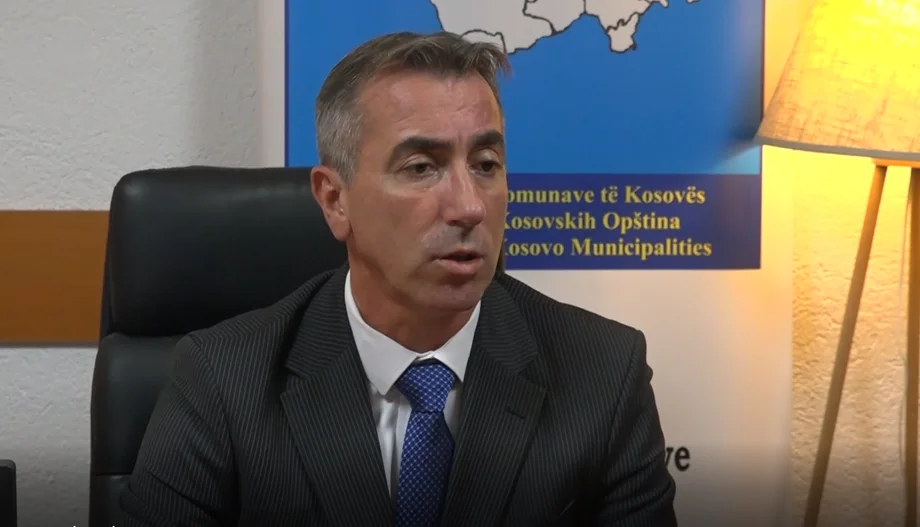
Ibrahimi: We are not against the collective agreement, but the central level should bear the financial burden
The Executive Director of the Association of Kosovo Municipalities (AKK), Sazan Ibrahimi, has stated that the AKK and mayors have never been against the collective agreement and respect for the rights of education workers, but they oppose having the costs of its implementation covered by municipal budgets.
In an interview with Ekonomia Online, Ibrahimi emphasized that the United Trade Union of Education, Science and Culture (SBASHK), when signing the collective agreement with the Ministry of Education, should have been aware that the financial resources for its implementation needed to be provided by the central level and not imposed on municipalities.
“However, we as an association have been against the financial resources being unjustly taken from municipalities ever since the signing of the first agreement and up to now. When SBASHK signed the agreement with the Ministry of Education, I believe it was aware that those financial resources should be provided by the Ministry of Education, since it was a signatory party, and not that SBASHK should sign an agreement with the ministry while handing the financial burden to the municipalities,” Ibrahimi said.
He said that this situation constitutes an injustice toward municipalities, which over the years have been burdened with considerable financial expenses, including the costs of court proceedings, enforcement proceedings and lawyers.
“After analyzing the situation, the Board of the Association of Kosovo Municipalities decided to recommend that municipalities not take on the financial burden, because up to now hundreds of millions of euros have been unjustly taken from municipalities, including for court proceedings, enforcement proceedings and lawyers. This amount has increased by more than 30%, with many millions of euros, hundreds of millions of euros, more than 100 million euros, having gone toward court proceedings, enforcement proceedings and lawyers in recent years,” he said.
Ibrahimi warned that if SBASHK seeks the signing of a new collective agreement, municipalities should not be considered responsible for the financial burden.
“So, SBASHK should not assume that under the new collective agreement, if it is signed, municipalities of the Republic of Kosovo will bear the financial burden, because hundreds of municipal projects in infrastructure, subsidies, goods and services have been halted because of the collective agreement, and we believe that SBASHK should come to its senses and, if it wants a new collective agreement, the central level should bear the financial burden,” Ibrahimi told Ekonomia Online.
He emphasized that this issue could be resolved by establishing a separate budget line in the budget of the Republic of Kosovo.
“The budget line, too. The central level sets the budget line, meaning that if the central level wanted to resolve this problem now, it could do so very easily; it could establish a budget line in the budget of the Republic of Kosovo for next year, to which several million euros could be allocated for the implementation of the collective agreement,” Ibrahimi told Ekonomia Online.
According to him, the Ministry of Education can propose a budget line to cover the cost of the collective agreement, which would then be reviewed and approved by the Government and the Assembly of Kosovo.
He explained that the Education Grant is proposed by the Ministry of Education at the central level and is then included in the budget of the Republic of Kosovo as a grant earmarked for municipalities, but it does not provide for covering the cost of the collective agreement.
“The Education Grant is a grant proposed by the Ministry of Education at the central level, and then, following the proposal by the Ministry of Education, the central level includes it in the budget of the Republic of Kosovo; it is a grant earmarked for the municipalities of the Republic of Kosovo, but under no circumstances does this grant provide for covering the cost of the collective agreement. So, if it wanted to, the Ministry of Education could add a budget line to cover the collective agreement; it would go to the government, could be approved, then go to parliament and be approved, and the problem would be resolved,” he said.
Ibrahimi reiterated that SBASHK should address the issue of financing the new collective agreement to the Ministry of Finance and the Government of Kosovo, excluding municipal budgets from this responsibility.
“That is to say, if SBASHK wants new collective agreements, it should consider that the Ministry of Finance or the Government of the Republic should bear the financial burden, and under no circumstances should it assume that municipalities can cover this extraordinary financial burden, which has harmed hundreds of projects that would have gone toward improving citizens’ lives,” he said.
The AKK executive director said that the issue of the new collective agreement had also been discussed at a meeting of the Collegium of the Association of Kosovo Municipalities, attended by municipal directors of education, Education Minister Hajrulla Çeku and representatives of SBASHK.
“The Collegium of the Association of Kosovo Municipalities, made up of municipal directors of education, attended a joint meeting also attended by Minister Çeku and representatives of SBASHK. The new collective agreement was discussed, but to my knowledge, even at that time the municipal directors made it clear that they supported a new collective agreement, but that the Ministry of Education, and under no circumstances the municipalities, should bear the financial burden,” Ibrahimi said.
He said that they had discussed the same position with some of the municipal directors of education and that this was also the position of the Board of the Association of Kosovo Municipalities.
“The conclusion of the Board of the Association of Kosovo Municipalities is that SBASHK may sign a new collective agreement, but it must under no circumstances count on municipal budgets,” Ibrahimi concluded.
A few days ago, the Association of Kosovo Municipalities (AKK) reacted to statements by SBASHK representatives who, according to the association, were attributing to municipalities responsibility for the financial consequences of collective agreements signed at the central level.
In a public response, the AKK Board said that municipalities had always respected and supported the rights of education workers, but did not have the budgetary capacity to cover the financial obligations arising from these agreements.
According to the AKK, the agreements were negotiated and signed at the central level, and therefore responsibility for providing the financial resources should also lie with the central institutions.