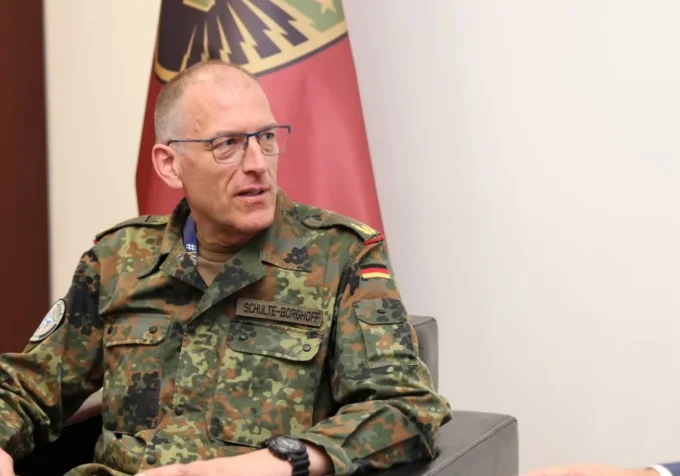
Ten Years of NALT in Kosovo – General Schulte-Borghoff Speaks About the Mission’s Role and the KSF’s Progress
The NATO Advisory and Liaison Team (NALT) marks ten years since its establishment, a decade of commitment in support of developing civilian protection capabilities and the democratic oversight of security organizations in Kosovo. On this occasion, NALT Director Brigadier General Thomas Schulte-Borghoff speaks in an exclusive interview with Telegrafi about the team’s mission, cooperation […]
The NATO Advisory and Liaison Team (NALT) marks ten years since its establishment, a decade of commitment in support of developing civilian protection capabilities and the democratic oversight of security organizations in Kosovo.
On this occasion, NALT Director Brigadier General Thomas Schulte-Borghoff speaks in an exclusive interview with Telegrafi about the team’s mission, cooperation with the Kosovo Security Force and the Emergency Management Agency, as well as its priorities for the future.
NALT consists of 50 members from 13 NATO member countries, including personnel from Kosovo. It operates under a mandate separate from that of KFOR and advises the KSF in accordance with its original mandate for civilian protection.
Schulte-Borghoff praises the KSF’s progress in responding to emergencies, while underscoring the need to strengthen logistics and human resource management so that these capabilities remain sustainable. He also explains the day-to-day coordination with KFOR and the commitment to the security of all communities in Kosovo.
Below, the full interview:
Telegrafi: NALT is marking its tenth anniversary. For those who may not be familiar with this NATO team, what is NALT, what is its mission in Kosovo, and what does this anniversary represent?
Thomas Schulte-Borghoff: We are a team of fifty (50) members from thirteen (13) NATO member countries, including personnel from Kosovo. NALT is NATO’s second mission in Kosovo, with a mandate separate from that of KFOR. We provide advice on activities related to building the capacity of security organizations in Kosovo. This advisory support has two aims: ensuring effective civilian oversight and developing adequate force structures to support civilian authorities, as well as effective civil emergency planning. My team of advisers is active throughout Kosovo, holding daily meetings with counterparts in the Kosovo Security Force (KSF) and the Emergency Management Agency. We advise the KSF in accordance with its original mandate for civilian protection. Through this engagement, we contribute to supporting lasting security for all communities in Kosovo, as well as stability in the region and beyond.
Telegrafi: NATO supported the disbandment of the Kosovo Protection Corps (KPC) and the establishment of the Kosovo Security Force (KSF). What are the main achievements of this engagement, and how has NALT contributed over the past ten years?
Thomas Schulte-Borghoff: Citizens and institutions in Kosovo can see the progress made in developing the Kosovo Security Force’s (KSF) civilian protection capabilities. These capabilities have been put to use both in Kosovo and in the region to respond to various emergencies, ranging from forest fires, hazardous materials and explosive devices to search and rescue operations. I am convinced that many readers have seen the KSF’s valuable role as a first responder in such cases, almost every day. Our role has been to support the KSF in developing and maintaining these capabilities, and I am very pleased with the progress the KSF has made in this area. Alongside developing these capabilities, we have also supported the development of effective civilian oversight mechanisms for the management of the KSF. NATO places particular importance on ensuring the democratic accountability of security forces, and it is encouraging to see that the KSF leadership shares this position, as I can confirm from my meetings and discussions with its representatives.
Telegrafi: What does a typical working day look like for you? Which institutions do you work with, and in what areas do you provide advice and support?
Thomas Schulte-Borghoff: There is no typical working day for an adviser, since our work covers a broad range of issues, from planning, budgeting, human resource management, medical support and logistics to the representation of non-majority communities and gender representation. All members of my advisory team are experienced professionals, whether military or civilian, who bring valuable expertise and knowledge to share.
Telegrafi: NALT’s mandate has remained unchanged for ten years. How do you adapt your support to the current needs of security organizations in Kosovo, both in terms of democratic oversight and the development of force structures?
Thomas Schulte-Borghoff: Our mission has not changed, but we adapt to the changing requirements of our counterparts and to the ever-changing context of our work. Naturally, some areas fall outside our mandate, but we can adapt where possible. One example is our support for building resilience in Kosovo. Recognizing the importance of this area, we have created a dedicated resilience adviser position within our team to support our counterparts in advancing their work and efforts in this important field. I am committed to adapting our future activities in line with guidance from NATO leadership and the needs of our counterparts in Kosovo.

Thomas Schulte-BorghoffPhoto: NALT
Telegrafi: How would you assess your cooperation with the KSF and other security institutions in Kosovo? What are the main needs you have identified through this cooperation?
Thomas Schulte-Borghoff: We work with security organizations in Kosovo every day. During their missions, which can last over a year, our advisers build strong working relationships and trust with their counterparts. With its existing capabilities, Kosovo is already quite well prepared. However, alongside the development of the KSF, it is essential to devote particular attention to support functions, including logistics and human resource management. This will ensure that emergency response provision is sustainable in the future. We can continue to provide support in this area, always in line with the KSF’s original mandate for civilian protection.
Telegrafi: NALT and KFOR are both part of NATO, but have different mandates. What will your priorities be going forward, and how will you coordinate your activities with KFOR and Kosovo’s institutions?
Thomas Schulte-Borghoff: We are based at “Film City” camp in Pristina, where KFOR Headquarters is located. Therefore, we coordinate closely with KFOR on a daily basis. Despite our different mandates, we share NATO’s overall commitment to contributing to security in Kosovo for the benefit of all communities and, through this, to regional stability. Our efforts are therefore complementary and mutually supportive. This commitment remains unchanged and continues to be among the top priorities on NATO’s agenda. I hope Kosovo will continue to give due importance to the significant achievements made so far in developing civilian protection capabilities and build on these results in the future, in the service and for the benefit of all communities./Telegrafi/.