Members of the OSCE mission were followed and surveilled by the BIA during Serbia’s 2023 elections
In mid-November 2023, ahead of the early parliamentary elections, foreign observers began arriving in Serbia as members of the OSCE mission, tasked with monitoring the elections scheduled for December 17. The plan was for the observers to spend about a month in cities across the country.
At Serbia’s invitation, the OSCE Office for Democratic Institutions and Human Rights (ODIHR) recruited mission members to monitor the conduct and financing of campaigns, media coverage, the resolution of complaints, as well as possible voter intimidation and the misuse of state resources.
Among the foreign observers were German Jana Burgers and Irishman Brian MacMahon.
They landed in Belgrade on November 19. Three days later, their driver took them to Novi Sad, from where they monitored the electoral process the following month.
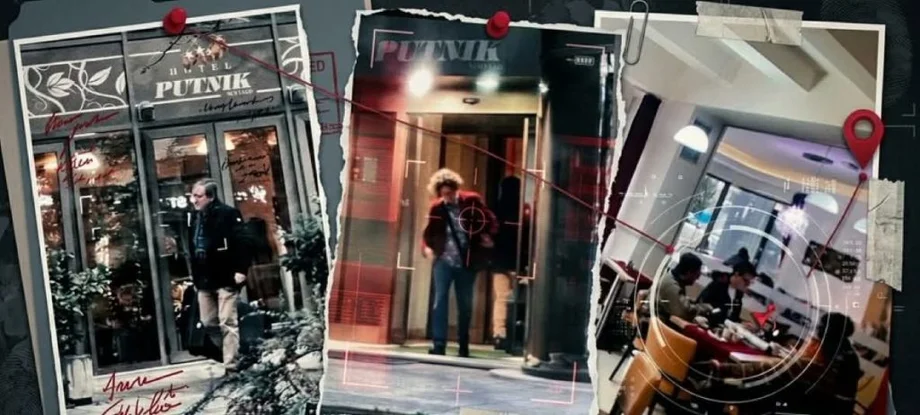
Burgers and MacMahon arrived at the Putnik Hotel in Novi Sad in the morning – November 22, 2023. From the moment the foreign observers got out of the car and entered the hotel, their every move was monitored by the Security Information Agency (BIA), BIRN’s investigation shows.
Photos taken by BIA members while monitoring the foreign observers show that agents monitored their meetings with their driver and assistant.
Brian MacMahon says he did not notice anything unusual during his stay in Novi Sad. He learned from a BIRN journalist that secret agents had been following him.
“This is unacceptable interference in missions. And if you remember, the basis of the OSCE is that all countries, 57 countries, agree to invite one another. So, in other words, we were invited voluntarily, and then being monitored sounds very ominous. I’ve never encountered anything like that, and I’ve done many missions; I’ve never encountered any sign of surveillance before. This raises the question of what those in power thought they were doing at a time when, on the one hand, they were inviting us and, on the other, monitoring us,” he said.
Jana Burgers also learned from a BIRN journalist that she had been under secret surveillance during her stay in Serbia. She says it is unclear what the purpose of such monitoring was.
“We usually don’t do anything in secret, and part of our work methodology is to be transparent and publish everything we discover. Of course, we don’t mention the names of every person we speak to in our public reports, but all the information can be traced back to its source.
Of course, if we hear someone say, ‘Please don’t tell others that you spoke with us,’ we certainly respect that,” Burgers said.
Burgers and MacMahon say they spent only their first night at the Putnik Hotel and that the accommodation had been booked in advance by the ODIHR observation mission.
Later, they moved into private apartments that they rented themselves.
“We had two apartments. Jana had one and I had one, and we used mine as a kind of office. The landlord, the owner, I think lived in Sweden, as I recall, because I spoke with him a few times,” MacMahon said.
According to information obtained by BIRN, BIA agents had the keys to their hotel rooms and also hired agents to check those rooms. More than a dozen BIA agents were involved in tracking Burgers and MacMahon.
The BIA also had the addresses where they rented apartments, information about the landlords, and the entry-door codes for the buildings even before the foreign observers began staying in privately rented accommodation in Novi Sad.
Jana Burgers tells BIRN that although she had heard about this from opposition members, she had no idea that she too was part of the secret service’s mass surveillance in Serbia.
“We heard from some of the opposition members we spoke to that they were facing problems and threats. We actually met a man who was beaten up later. You hear these stories quite often, but when you speak with the person and later receive a photo and a message saying, ‘No, I can’t meet you because I’m in the hospital…’ That was heartbreaking,” she said.
ODHIR did not respond to BIRN journalists’ questions about whether they had conducted an investigation and how they comment on the information concerning the secret surveillance of their members. The long-term observation mission for the early parliamentary elections in December 2023 consisted of 30 people from 12 countries.
BIA followed election observers
So far, Jana Burgers has worked on observation missions in Ukraine, Kyrgyzstan, Bosnia and Herzegovina, and the USA. And this, she says, is the first time she has discovered that she was a “target” of the secret service.
“One day in St. Petersburg, I know colleagues on the Russian mission—I mean, they were followed and watched in a way that was really obstructive. So they complained, they realized what was happening, they complained to the mission headquarters, and the core team actually contacted whoever it was—the Secret Service or the KGB or whatever—and said, you know, either stop it, or we’ll shut down the whole mission,” Burgers says.
Brian MacMahon took part as an observer in missions in Georgia, Russia and Serbia, among others.
“This is an observation by an observer. But I don’t know whether they could have found out or changed much by doing it. They couldn’t have arrested us because it would have been an international incident, I would say. The Ministry of Foreign Affairs in Ireland employs us for the OSCE, and they would probably be surprised and a little disappointed to hear that we were being monitored in that way,” MacMahon said.
The Security Information Agency did not respond to BIRN’s questions about why it followed the foreign observers and whether it had a court order to do so. At the time ODIHR observers were being monitored in Novi Sad, there were changes in the leadership of the BIA.
Specifically, Aleksandar Vulin resigned on November 3, 2023, and his first deputy, Tomislav Radovanović, took over the BIA. He was also appointed acting director of the Agency in December of that year.
Radovanović had previously served as police attaché in France, then was appointed head of the Special Investigative Methods Service of the Criminal Police Directorate (UKP), which conducts secret field surveillance and recording, as well as monitoring telephone, electronic and other forms of communication. At the beginning of 2023, he transferred to the Security Information Agency, where his superior was Aleksandar Vulin, who resigned on November 3, 2023.
He became known to the public several years ago when he said on a television programme that there was a parallel structure within the MUP that was wiretapping Serbian President Aleksandar Vučić, and characterized the inspectors involved in uncovering it as people who had in fact attacked and tried to criminalize the family of then-President Vučić.
Since June 2024, Tomislav Radovanović has been appointed deputy director of the BIA and continues to hold that position, which is colloquially known as the agency’s “number one operative.”/The GeoPost