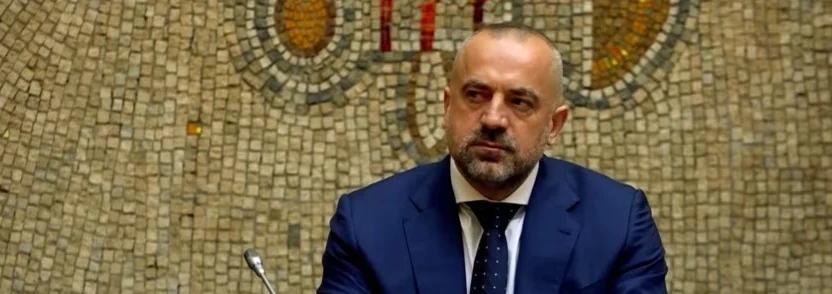
Who is seeking Milan Radoičić, and who protected him?
Milan Radoičić, a former politician and businessman, a person on the American “blacklist,” a name on Interpol’s wanted list and someone Kosovo is seeking to have extradited. Since November 17, when the High Court in Belgrade issued an arrest warrant for him, he can also be considered Serbia’s most well-known fugitive from justice.
Under the watch of Serbia’s technical government, led by outgoing Prime Minister Đuro Macut, and while Ivica Dačić is serving as interior minister in a caretaker capacity, all trace of him disappears.
Who is responsible?
“I don’t know whether he [Dačić] is part of the decision-making chain of command,” says Igor Bandović, director of the non-governmental organization Belgrade Centre for Security Policy (BCBP), in response to a question about whether Ivica Dačić can be held responsible for Milan Radoičić’s disappearance.
“According to some of our information and data, Ivica Dačić was absolutely not consulted about the deployment of the police, or about decision-making at key stages and the decisions made by the police. So his political responsibility certainly exists, as does responsibility for failing to act. However, I think the issue here is—and I will mention it, as has also been said here—that it was primarily the leader of the Serbian Progressive Party, that is, the former government, that made these decisions concerning the police,” Bandović says in an interview for “Uvid,” a program by Radio Free Europe’s (RFE) Balkan Service.
Dačić has not commented on this incident. He is the leader of the Socialist Party of Serbia, which failed to enter Parliament in the parliamentary elections held in Serbia on October 25. The party won 2.13 percent of the vote and fell short of the 5 percent electoral threshold.
Thus, at least for now, Dačić’s period of success in keeping the Socialists in power—thanks to alliances with governing parties—comes to an end. This political maneuver enabled him to be appointed interior minister four times, most recently in April 2025.
As minister for Kosovo, Goran Bogdanović was part of the Serbian government led by Prime Minister Mirko Cvetković, from 2008 until Aleksandar Vučić and his party, the Serbian Progressive Party (SNS), returned to power in 2012.
“I had the opportunity to work with him [Dačić] for four years. Even in our time, he pretended that nothing was up to him, while in reality he used the benefits he had both for himself and for his people,” says Bogdanović.
“If we abide by the laws of the Republic of Serbia, I think there should be accountability, not only political accountability. How is it possible that Ivica Dačić, as interior minister, was not consulted? I can judge from my own experience as a minister. If I had not been consulted, if I had not been making decisions, I would have resigned automatically. I cannot bear only political responsibility. I think accountability must begin, first and foremost, with the BIA [Security Intelligence Agency of Serbia], the Police Directorate and, of course, the minister. We cannot keep pretending we don’t see things forever,” Bogdanović explains his position.
Who is seeking Radoičić?
At the request of Kosovo’s Ministry of Internal Affairs and through UNMIK’s mediation, Interpol issued an arrest warrant for Radoičić two months after the attack in Banjska.
The attack on Kosovo Police in Banjska took place on September 24, 2023, when a group of armed Serbs killed Kosovo police officer Afrim Bunjaku. Three Serbian attackers were also killed in the exchange of fire.
However, the main international interest in this Serb from Kosovo dates back to December 8, 2021.
On that day, the U.S. Treasury Department’s Office of Foreign Assets Control (OFAC) imposed sanctions on Radoičić. He was identified as a member of an organized criminal group led by Zvonko Veselinović, which is said to be involved in smuggling goods, money, narcotics and weapons, corruption in the awarding of infrastructure project contracts, and bribing state officials.
Since then, both have been on the so-called American “blacklist.” Veselinović and Radoičić are regularly linked to each other, although the former has never been involved in politics, but has done business in at least three Balkan countries. Their businesses have often been accompanied by speculation about the privileged position they enjoy thanks to their ties to political circles. Zvonko Veselinović left Serbia two weeks after the October elections, travelling via Sarajevo to Istanbul. It is not known whether he subsequently stayed in Turkey.
After the attack in Banjska, another crime was added to those linked to Radoičić—one that is likely the most serious: terrorism.
Kosovo blames Serbia for the attack, responsibility for which Radoičić claimed. But Belgrade has denied any involvement.
“In Radoičić’s case, there are elements of the crime of international terrorism. If we recall how Banjska was characterized, first and foremost by the European Union and then by the United States, the crime of terrorism is mentioned. Of course, the Serbian court has not characterized it this way, but here we have, I would say, an offense that is more dangerous to society and more dangerous internationally than in the case of (Miloš) Medenica,” says Igor Bandović, comparing Radoičić with the case of another fugitive from justice, Miloš Medenica.
Medenica was sentenced by a court in Montenegro in January 2026 to ten years and two months in prison, among other things for the crime of creating a criminal organization. Since then, he has been on the run and often posts comments on social media about events in Serbia, frequently targeting Serbia’s former president and now SNS leader, Aleksandar Vučić.
How was it determined that Radoičić was not in Serbia?
On November 15, Radoičić was expected to report to the Savski Venac police station in Belgrade, but he did not show up. Under the court ruling issued on October 4, 2023, he was required to report to the police on the 1st and 15th of every month. Two days after he failed to report, an arrest warrant was issued for him.
Three years earlier, Radoičić’s passport had been confiscated, and he had been banned from leaving Serbia and from going to Kosovo, which is asking Serbia to extradite him over the attack in Banjska, in northern Kosovo, on September 24, 2023.
Also, three members of the group of Serbs who carried out the attack in Banjska were sentenced by a court in Kosovo in April 2026, two of them to life imprisonment, while Radoičić, who admitted organizing the attack, took refuge in Serbia.
As for where he lived before disappearing, it may have been a villa with a swimming pool and a fenced yard, built without official building permit records, in Belgrade’s affluent Dedinje neighborhood, within the jurisdiction of the police station where he was required to report.
The plot on which the building was constructed is listed as the “joint property of the spouses,” Milan and Ema Radoičić. But Ema Radoičić is listed as the home’s sole current owner.
He has not appeared in court during the three years since the attack in Banjska. In Serbia, criminal proceedings have been initiated against him for offenses against public safety, including the manufacture, possession, carrying and trading of weapons, but no indictment has been filed to date.
Did Vučić protect Radoičić?
It is easier to answer if the question is asked the other way around. Vučić’s political sympathies for Radoičić were evident in a way before the parliamentary elections, when he appeared at an SNS rally outside the “Jezero” hall in Kragujevac. In a video by N1 television dated October 9, 2026, he can be seen alongside Danilo Vučić, the president’s son.
European Union officials have repeatedly called on the Serbian authorities to prosecute Radoičić. Most recently, after his appearance at the rally in Kragujevac, they expressed disappointment.
“We are disappointed that Serbia has so far not taken the necessary steps to arrest and prosecute, on appropriate charges, those who are in Serbia,” the EU said in its comments, alluding to Radoičić’s role in Banjska.
As for the former Serbian president’s attitude toward Radoičić, Vučić insisted that he would answer summonses from the court in Serbia and would not hide or flee.
“If anyone thought he [Radoičić] would flee or hide, he won’t,” Vučić said after the attack in Banjska.
“He considers himself a freedom fighter; he has never abandoned his comrades and never will,” he explained.
Political ties stem from the relationship built between the Serbian List, where Radoičić was deputy leader until he resigned five days after the events in Banjska, and Vučić’s Progressives.
The Serbian List has politically dominated Kosovo’s Serb-majority municipalities for the past 13 years. Radoičić was deputy leader from 2018 to 2023, when the party was led by Goran Rakić, who is currently an MP for Vučić’s Progressives in the Serbian Parliament.
With Vučić’s decline in Serbia, the position of the Serbian List in Kosovo is inevitably also being reconsidered.
Is northern Kosovo “breathing more freely”?
“Believe me, over the past few weeks, we feel freer to think and express our thoughts and knowledge,” says Bogdanović, who gave the interview from Leposavić, one of the four Serb-majority municipalities in northern Kosovo.
“For example, a grocery store in Leposavić run by Albanians was boycotted; nobody dared go in. Very few people had the courage to go into ‘Interex’ to shop, even though the goods were at least 30–40 percent cheaper than in Serbian shops. But now—I was there a few days ago—do you know how many people there are? Do you know how many people have dared to come and shop?”
“But these people, that Serbian List, are our greatest enemies, more so than the Albanians, if they can be called enemies. They have terrorized the Serbs,” says Bogdanović.
“Here’s the latest example—the elections. I, for instance, waited five hours each way when I went to vote in Raška. You should see the misery. People walk there.
I know some of them, and I ask them: ‘What makes you do it?’ They say: ‘Ah, we have to, you know how they threaten us, they called us, we hadn’t planned to go.’ You know what it’s like when you force an ordinary citizen to go and vote. It may seem insignificant, but tomorrow it could also become a matter of keeping your job,” this interlocutor concludes.
Does the Student List have a position on the “Radoičić case”?
Promising to review the previous government’s international agreements, including the Brussels Agreement on the normalization of relations between Serbia and Kosovo, the Student List is also avoiding cooperation with the Serbian List.
Jugoslav Gašić, an MP from this list, has said that they will communicate with the Serbian List through the international community.
However, when it comes to positions on issues related to Kosovo, including Milan Radoičić, the winners of the elections in Serbia have largely avoided commenting or stating more detailed positions during the first month after their victory.
“Yes, I think that’s true, but in this specific case, I don’t think so,” says Goran Bandović.
“The Student List has not yet formed a government. It’s true that they haven’t said much about foreign policy, Kosovo and so on. But this case is not only about Kosovo and foreign policy; it is precisely about how the entire Kosovo issue has been left in the hands of organized crime and corruption. I believe they will have a lot to say on this issue because, among other things, it is one of their priorities—the rule of law,” Bandović concludes.