Why Should Kosovo Honor the Philosopher Jürgen Habermas with a Public Space in Pristina?
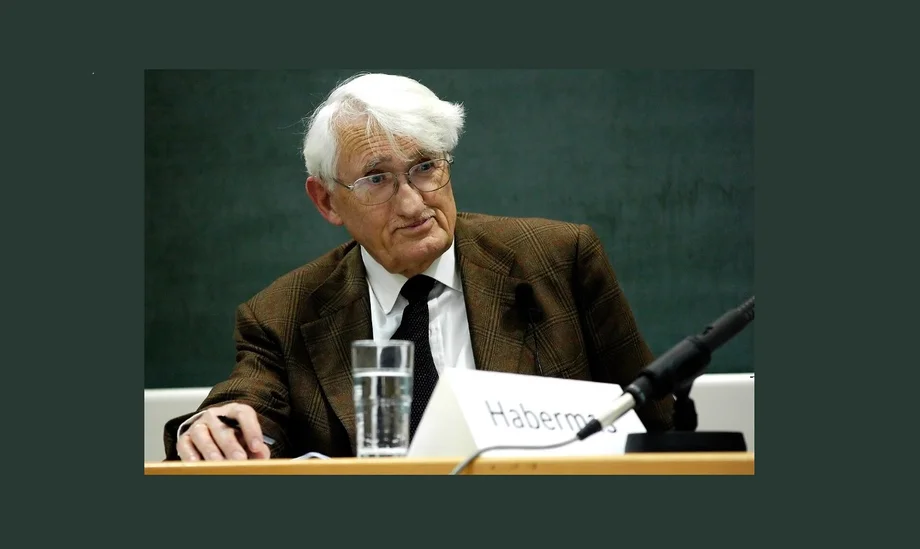
The philosopher Jürgen Habermas was one of the brightest minds in contemporary philosophical and political thought in Europe and beyond. He was a thinker who reactivated the critical project of the Enlightenment through his interventions in the public debates of his time. His recent death leaves a great void in world philosophical thought. His body of work […]
The philosopher Jürgen Habermas was one of the brightest minds in contemporary philosophical and political thought in Europe and beyond. He was a thinker who reactivated the critical project of the Enlightenment through his interventions in the public debates of his time. His recent death leaves a great void in world philosophical thought.
His major philosophical work, The Theory of Communicative Action, represents one of the most important milestones in contemporary social theory. In this work, he developed the concept of communicative rationality as a counterweight to the dominance of instrumental rationality in the bureaucratic and economic systems of modernity.
From a philosophical perspective, Habermas reminds us that democratic society cannot rest solely on mechanisms of power or on the logic of the economic system. It must rest on what he called the deliberative public sphere—a space where citizens engage in rational discourse to produce political legitimacy. This is why, for Habermas, democracy was not merely an institutional procedure, but above all a discursive process through which the collective will is formed.
In the political sphere, Habermas was one of the strongest defenders of the European project. For him, Europe was not simply an economic or institutional union, but a post-national normative project built on universal values such as democracy, human rights, and transnational solidarity. He often criticized what he called the European Union’s democratic deficit, arguing that European integration must be accompanied by a European public sphere and a new form of shared civic sovereignty.
Nevertheless, his philosophy did not remain confined to theoretical abstractions. Habermas was one of the European intellectuals who took a clear stand at critical moments in the continent’s history. One such moment was NATO’s intervention in 1999 against Slobodan Milošević’s regime. Unlike some on the European left who opposed the intervention, Habermas considered it legitimate on the basis of the universal ethic of human rights, arguing that in extreme situations the international community has a responsibility to intervene to protect civilian populations from systematic crimes. For him, this was not a breach of international law, but a step toward transforming it in the direction of a cosmopolitan legal order.
From a philosophical perspective, Habermas’s position on Kosovo should not be seen merely as a political stance of the moment, but as part of his theoretical framework concerning universal rights and the moral responsibility of the international community. Kosovo became one of the cases in which his idea of an international order based on normativity, rather than merely on state sovereignty, was put to the test. For a philosopher who had spent his life reflecting on the crimes of Nazism and Europe’s historical responsibility, indifference to ethnic cleansing in the Balkans was not a moral option.
For this reason, remembering Habermas is not only a matter for philosophers, but also for society and public decision-makers. He is not only one of the most important philosophers of contemporary political thought, but also a moral voice who, at the critical moment of 1999, supported humanitarian intervention against Milošević’s regime, linking political argument to the universal ethic of human rights.
Honoring him with a public space in Pristina would be meaningful not only as an act of historical gratitude, but also as a symbolic statement about the European orientation and democratic culture that Kosovo seeks to build. Habermas reminds us that democracy is not merely an institution, but above all dialogue, public reasoning, and moral responsibility toward others.
A square or street bearing his name would serve as a lasting reminder that democratic societies survive only when citizens believe in the power of reason and rational debate—values that are more necessary than ever today.
Ultimately, what remains of Habermas is a fundamental thesis: democratic societies can survive only if their citizens believe in the power of reason and dialogue. At a time when truth is often replaced by propaganda, this idea remains perhaps more relevant than ever. Habermas’s philosophy did not end with his death; it continues to live on in every effort to build a society based on discourse, rationality, and justice.
__
Ridvan Emini is Chair of the Association of Philosophers of Kosovo