
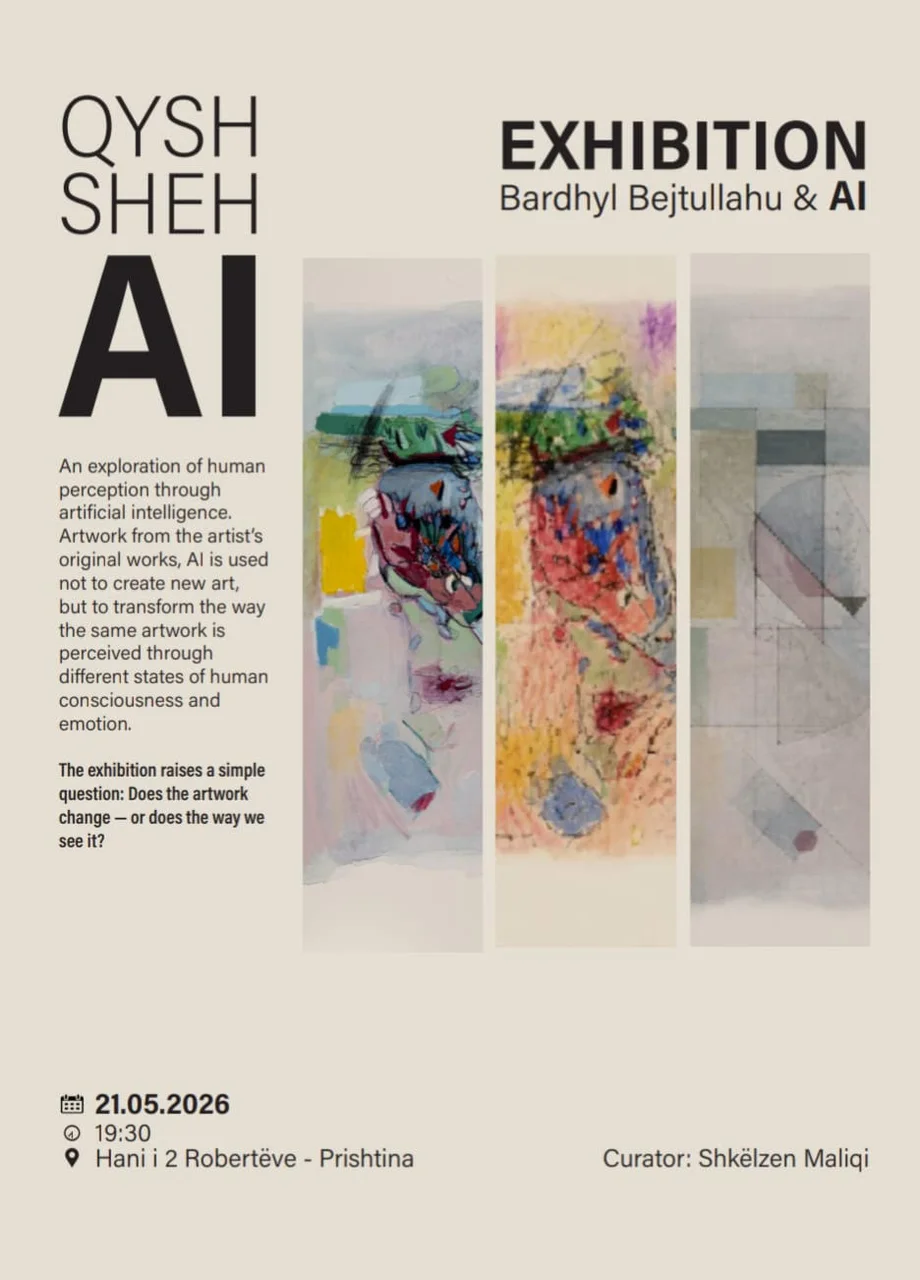
HOW AI SEES, an exhibition by Bardhyl Bejtullahu
Artificial intelligence (AI) has in recent years become a major topic of conversation about humanity’s future, accompanied by alarming predictions of the end of humankind, driven by fears that AI will prevail in every field. Artist Bardhyl Bejtullahu presents an exhibition at “Hani i 2 Roberëve,” where he brings original artistic motivation, emotion and creativity face to face with AI’s imaginative power […]
Artificial intelligence (AI) has in recent years become a major topic of conversation about humanity’s future, accompanied by alarming predictions of the end of humankind, driven by fears that AI will prevail in every field.
Artist Bardhyl Bejtullahu presents an exhibition at “Hani i 2 Roberëve,” where he brings the artist’s original motivation, emotion and creativity face to face with AI’s imaginative power, when it is tasked with creating works on the same themes as the author’s originals, generating them as seen through the eyes of a child, an elderly person, an architect, a psychiatrist, and so on. The outcome of this challenge reveals an interesting spectrum of kindred images, confronting us with the question of original authorship and generated authorship. In this experiment, AI becomes a tool for producing versions of the same work; those that can be generated infinitely, without being mere copies, also bear Bejtullahu’s mark of authorship, as a kind of expanded, multiversal authorship.
Bardhyl Bejtullahu’s original paintings stand out for their carefully studied, well-balanced compositions. They radiate optimism, as the artist often sets them against a resonant whiteness that gives the paintings’ motifs a luminous aura, while the fluidity and transparency of acrylic paint and pastel lend the colors the spontaneity and delicacy of watercolor.
Another distinctive compositional feature is the elongation of structural forms, which renders the landscapes stylized, so that trees and houses have vertical extensions, while the abstract works present fundamental dynamic relationships in the subtle intersection between the vertical and horizontal visual vectors, or between the celestial and the terrestrial in the generation and structuring of perceptible aesthetic reality. Light and whiteness dominate Bejtullahu’s work not as a way of closing one’s eyes to the darkness and toxicity of contemporary life, but as a deliberate contrast to the horrors that engaged art sounds the alarm about as major threats to survival. We humans still need to see the beauty of oases, too.
Nevertheless, the exhibition’s main intention remains to address the challenge of AI. His perceptual optimism puts artificial intelligence to the test as a creative genius, reminding us that AI, as a tool created by humans, must not surpass us in what matters most to us — the heart and soul.
— Shkëlzen Maliqi
As the artist himself puts it:
“Through this exhibition, I have not sought to have artificial intelligence create new works. I have sought to see how the same work can be perceived differently when it passes through different human consciousnesses, states and ways of seeing.
AI, in this case, is not the author of the work, but a tool for perceptual transformation.
The work remains the same.
Only the way we see it changes.”
— Bardhyl Bejtullahu
The exhibition is curated by Shkëlzen Maliqi.
📍 Hani i 2 Roberëve — Pristina
📅 May 21, 2026
🕢 7:30 p.m.














