
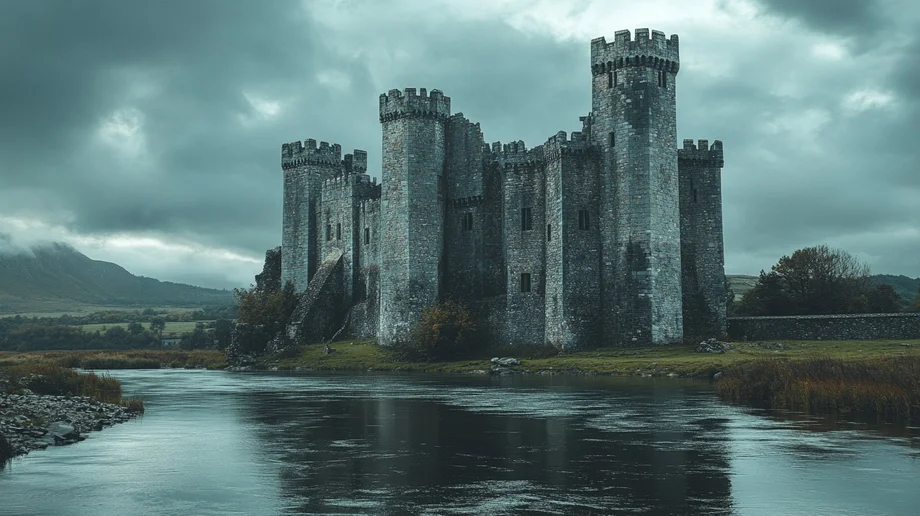
The Castle of Memory
Author: Mentor Tahiri Here, beside the castle, one senses something in the air. An invisible, diffuse presence, formed from the remnants of bygone times. A feeling shaped by centuries and by the call of the ancestors. I have waited a long time to come. It is more than a journey. It is the longing the stories left me with. […]
Author: Mentor Tahiri
Here, beside the castle, one senses something in the air. An invisible, diffuse presence, formed from the remnants of bygone times. A feeling shaped by centuries and by the call of the ancestors.
I have waited a long time to come. It is more than a journey. It is the longing the stories left me with. Those that nourish every person's soul.
My steps along the paths of well-trodden stone undo the melody of silence. The gentle breeze carries the scent of rain over ancient walls and the traces of the footsteps of those who once passed this way.
From here, armies set out in haste on horses watered to their fill. They returned exhausted, with bloodied horses. The same was true when merchants returned weary with their caravans, counting the plundering attacks, often imaginary, in their convincing effort not to lower the price of the goods they had brought from who knows where.
In the background, the clash of Hungarian and Ottoman swords against the breastplates of this land can be heard. A rumble that still seems to vibrate in the depths of the earth. Farther off, as if left for eternity, are the troubles of a brave king, holed up in the castle, facing the helplessness of his body to stand against the shadow of the bajloz.
A higher power has never stopped before the troubles of a king. Not even the greatest power has saved a person from their troubles. At this point, when the end is knocking, people are always equal to the king. The roles we have during life do not change our end.
In this space filled with memories and echoes, figures and voices pass like shadows. The castellan Dioniz and the dizdar Muhamed appear as two guardians of the same world. Father and son in the logic of the centuries, to save the one of their blood, making the arithmetic of years insignificant. Continuity lives on. So does the place, only with people. The easiest thing is to disappear.
Somewhere in the hierarchy of stories stands the Aga, with the Sultan's firman in his hand, a sign of an order built on law and iron. With the vakuf he established, he left a mark on the lives of the people who gathered around him. Conscious of the seal he left on the pages of time, even he did not manage to take all the castle's fame.
His son also stirred the poet to weave those twelve thousand lines of history, where bravery and love clash in the same spirit. The poem remains a song, remembered even when it is not written down. The highland bards do not need the text in front of them. They outwit writing when they pass the epic from generation to generation.
The past leaves its traces in the strangest ways, but it also leaves the most beautiful ones. The castle jealously keeps its secrets. We see only the fragments that defied disappearance, like the verses sheltered in Homeric memories. Above all these fragments lies a fragile coexistence between Christianity and Islam; breaths sharing the same air, but not always the same peace. A mosaic of identities that left behind place names, names, and traces. The faiths departed; the questions remained. The land still holds them.
Among all these flags, ordinary people have lived too. Those who existed with their silent fears and with desires that never made it into the chronicles. Someone dreamed only of a season without war, a table full of food, a child saved from hunger.
Someone else waited for a return that never came. Every evening, a woman stepped onto her doorstep, searching the horizon for the shadow of the husband war had taken from her. For months, and then for years, she learned to recognize every horseman approaching along the road, only to be disappointed again. At night, she was kept awake by worries the chronicler never wrote down anywhere.
Farther on, from the castle walls, a child ran toward the caravans appearing in the dust, hoping to find among them good news from afar about his older brother, who never returned. In the little hut beneath the walls, an old man counted the days not by a calendar, but by the bells and calls from the house of God, measuring time by what he heard and not by what he saw. Their lives never made it into the chronicles, but they were just as real as the wars, kings, and victories that filled the palimpsest.
Beside the river of willows and the asphalt roads that follow it like veins, this place remains a silent knot of the past. Bridges have never been mere crossings; they have been thresholds of fate, salvation for some, a curse for others. Like the bridges we cross today. The journey through life remains the same. I understand this nowhere more than here. Even now, the road passing beneath the castle connects the cities.
Written history remains merciless. It casts everything else into shadow. It selects the grandeur of the clash and passes quickly over individual experiences. Thus the tears of a mother go unwritten, as do lost loves and the anxiety of ordinary people.
Even the one who writes often pursues fame, because memory finds it difficult to survive without the renown of glory. That is why it remembers battles, conquests, and collective triumphs, as though each person's life were only a brief shadow beneath the weight of time.
Now everything seems more unclear to me. Reality slips from our grasp even when we hold on tight. History has no boundaries anymore. I am no longer sure where the story ends and memory begins; where substance is separated from the traces it has left behind, among what is visible and what cannot be seen. The past comes blurred, in a space where illusion and truth sometimes resemble one another.
Still, curiosity continues to scratch from within, searching for something that is no longer entirely clear, but not completely lost either. I stand on this land as a witness to memory. Others rule here now. This is the price of war. In the surrounding settlements, there are no more surnames of my blood.
Man destroys man, and flags often wave above the wounds of shame. In these parts, victories are proclaimed even when they are not real. The only presence of my ancestors remains the blood that does not dry and their gaze following me from the sky. It brings me what cannot be undone. It leaves me between pride and pain. I try to turn all of it into love.
No one knows what the future brings. It does not reveal its plans, nor the secrets hidden in the drawers of the cosmos where destinies are kept. Perhaps it is better this way. If we knew our paths in advance, we would also lose the mystery that keeps the human mind forever in motion.
Now, as I leave, I look at the castle, which is getting higher and higher in the distance. A guardian of time, defying the modern cities around it. Its stones hold more memory than we do. Perhaps that is why I return here. Not so much to find answers as to hear the questions that time has not yet silenced.
I say goodbye to the castle with more questions than when I arrived. Evening will find me beside a table. Soft music will cover the conversations at the tables around me. The aroma of coffee will try to confuse the feeling of the air in my castle of memory
I passed through villages. As I descend toward the nearby city, I see people competing with monuments in their chronic struggle for dominance. This is visible even through the car windows. In cities like this, there are two kinds of monuments, two kinds of religious buildings, and only one kind of people. That one kind of person who wakes up every day to the daily struggle to stay alive.
The questions come and multiply, but, just as at the castle, the city's roads offer no answers either. I find some comfort in thinking that unanswered questions are also a way of understanding life.
When sleep begins to call me and the castle dissolves into the evening, perhaps I understand that it did not survive the centuries because of its stones. Stones crumble. Nor because of kings, agas, or armies. They too are forgotten. The castle survived because every generation left a memory upon it. History hurts. It never ends. It simply continues to flow through the wounds of those who still know how to remember.














