
Kosovo Diary
What makes a place like this? Is it language? Ethnicity? A shared history? Geography? Is it easier to justify nationhood on an island, where the sea itself creates a boundary, than on a contested piece of land where every village contains a debate with the past? Or is a place simply a people determined to govern themselves and defend themselves from others?
What makes a place like this? Is it language? Ethnicity? A shared history? Geography? Is it easier to justify nationhood on an island, where the sea itself creates a boundary, than on a contested piece of land where every village contains a debate with the past? Or is a place simply a people determined to govern themselves and defend themselves from others?
The answer is less clear than we pretend, with our illusions about the inalienable rights of self-determination and ridiculous notions of indigeneity. The world today contains roughly 200 sovereign states. Is that the right number? Should there be more? Should there be fewer? What about supranational entities such as the European Union, where nations voluntarily pool aspects of sovereignty in the hope that borders will matter less? I think that could be useful. Am I alone?
Most people go on with their lives without thinking about such questions. And then there is Kosovo.
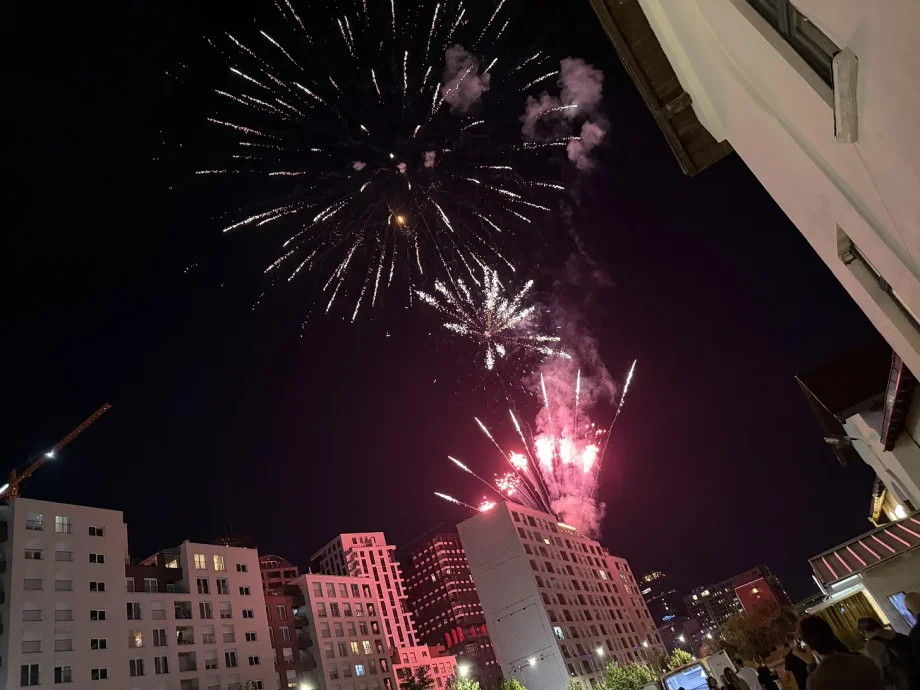
I’m here on Liberation Day, June 12, commemorating the end of NATO’s 1999 air campaign against Serbia and the arrival of international forces that would oversee Kosovo’s transition from a Serbian province to a protectorate and ultimately an independent state. Kosovo declared independence in 2008, making this the eighteenth year of its contested existence as a sovereign republic.
“Contested” is the key word, and you can feel it when talking to people here. Kosovo has a flag, borders, police, elections, ministries, passports, and a national football team. In most respects it functions as an independent country. Yet Serbia rejects its sovereignty. Russia and China reject it too. Five members of the European Union still refuse to recognize it. Kosovo remains outside the United Nations, compelled to justify its existence in ways most states never have to.
So Kosovo is a perfect illustration of the idea that there is no universally accepted formula for what makes a country. On the one hand, it can seem as though we are nothing without the recognition of others. On the other hand, to hell with the world. But not with the United States. I’ve rarely felt such appreciation for my American accent. I’ve never heard such adoration for Bill Clinton, who was president at the time. There’s a statue of him in the city center.

And here, to be clearer, is a cathedral whose donations were organized by Jewish American Democratic senator Chuck Schumer, on a boulevard named after the president of the time. Is that reasonable? I think that depends on your definition of the word “is.”

And if you want more churches, there’s also the unfinished Serbian Orthodox Church of Christ the Savior, standing strangely beside the University of Pristina campus like a stranded remnant of another era. Construction began under Milošević in the 1990s and stopped with the war, leaving behind a half-finished shell that is partly church, partly monument, partly provocation. For Serbs, it represents the enduring continuity of Orthodox Christianity in Kosovo. For Albanians, it symbolizes the political domination imposed during the final years of Serbian rule. Its meaning flows from its unfinished state.

Yes, indeed, the world map is a compromise and an accident, and the Balkans perhaps make this more apparent than anywhere else. The very word “Balkanization” entered the global vocabulary as shorthand for fragmentation—the fear that every community, valley, language group, or grievance might eventually demand its own flag and border crossing. Yet the irony is that the Balkans also produced one of the most successful multinational states in the communist world: Yugoslavia. I visited Belgrade in the early 1990s, when it was the most successful communist capital; it had a McDonald’s. I had no idea what lay ahead.
Under Marshal Tito, Yugoslavia charted an independent course between East and West. Its citizens traveled abroad. Western tourists filled the Adriatic coast. Serbs, Croats, Slovenes, Bosniaks, Macedonians, Montenegrins, Albanians, Hungarians, and others coexisted within a state that, for decades, seemed remarkably functional. Tito balanced competing nationalisms while suppressing them. After his death in 1980, the structure weakened. The economic crisis deepened. Nationalist leaders discovered that ethnic agitation mobilized people more effectively than socialist ideology ever could. The champion of this was Milošević. He wanted to keep Yugoslavia together, but under Serbia’s boot. Slovenia and Croatia broke away in 1991. Croatia proved bloody. Bosnia became catastrophic. Europe witnessed sieges, ethnic cleansing, concentration camps, massacres, and mass displacement on a scale many had considered impossible after 1945.

I remember those years clearly from my time with the AP in Vienna (which, in fact, is my next planned stop on this trip), watching reports arrive that at first seemed tragic but isolated. Looking back, they were the first glimpses of Europe’s deadliest conflict since World War II.
Again, America proved indispensable and helpful; it was a different time. Clinton’s envoy, Richard Holbrooke, cajoled, flattered, threatened, and wore down Balkan leaders until they signed the 1995 Dayton Accords, ending the war in Bosnia after nearly four years of massacres and siege warfare. The agreement preserved Bosnia as a single state but divided it into ethnic entities, freezing the conflict politically even as it halted the killing militarily.

Kosovo was the unfinished chapter. For Serbs, Kosovo occupies a place somewhere between history and mythology. The defining event is the 1389 Battle of Kosovo, when Serbian forces faced the advancing Ottoman Empire on the Kosovo Plain. Militarily, historians still debate aspects of the battle, but in Serbian national consciousness it became a story of sacrifice, resistance, and martyrdom. Kosovo evolved into the symbolic cradle of Serbian civilization, home to medieval monasteries and some of Serbian Orthodoxy’s holiest sites.
There was, however, one small problem: modern Kosovo was predominantly Albanian—the same ethnicity, speaking the same language, as the small country to the west, which had been among the most repressed by communist dictatorships.
Yugoslavia managed the tension imperfectly through autonomy arrangements, but when Yugoslavia collapsed, the contradiction exploded. Milošević’s revocation of Kosovo’s autonomy in 1989 intensified Albanian resistance. Parallel schools and institutions emerged. Initially, Kosovo’s independence movement was remarkably nonviolent. But as Yugoslavia disintegrated violently elsewhere, frustration deepened. By the late 1990s, the Kosovo Liberation Army had emerged, Serbian repression escalated, and Kosovo plunged into war.
The conflict culminated in 1998–99. Reports of atrocities, ethnic cleansing, and mass displacement prompted NATO to intervene militarily without clear authorization from the UN Security Council. In perhaps Europe’s largest exodus since World War II, more than a million people were driven from their homes by Serbian forces between March and June 1999.
“Some of us were teenagers and journalists in 1999 and have avoided talking about it for 30 years, covering Kosovo’s much more urgent issues,” said Jeta Xharra, journalist and co-founder of the Exodus 99 museum. “Now we are a slightly more normal country; enough time has passed that we no longer fear being hidden away and expelled again. We have rebuilt our country, but we have not healed our souls enough, or reflected enough on how we made it through.”

Surprisingly, few people outside this country know about this episode. The Serbs even took people’s identity cards so there would be no records. After NATO’s destruction of Serbia, they practically all returned. This week Jeta opened a small museum in their honor, housed in a decommissioned railway car. It’s a sight to see, I thought, as my new friend Petrit Selimi arranged a Japanese single-malt beer for me. Sad on the one hand; a good ending on the other; and in any case, a labor of love for Jeta.

Petrit had organized a conference this week on post-conflict reconciliation, and I was a guest speaker.

Petrit had long served as deputy foreign minister and briefly as foreign minister; well enough—he matters, and that made him a good person to ask about unification with Albania. So obvious, right? He considered it unrealistic. But, like others, he pointed out that if all the countries became members of the European Union, that would also make it somewhat irrelevant—united in everything but name. Sadly, he also thought EU accession was not possible in the foreseeable future—too much opposition, from the non-recognizers in the EU and others.
It’s hard for me to believe anyone is still listening to Serbia, which emerged greatly weakened from the Yugoslav wars and is currently a kind of backward nationalist swamp in Vladimir Putin’s pocket. But the fact is that whatever deal might be made with Serbia that would include broader recognition of Kosovo has yet to happen. Nevertheless, Petrit believes Kosovo’s efforts to join the EU will bring better governance, which seems to be the only political issue in a country you might think would be more geopolitical.
Petrit is also very concerned about post-conflict justice. More Albanians than Serbs have been tried in Kosovo for wartime crimes, which people attribute to an effort to impress outsiders. The consensus, he says, is that it hasn’t worked. This also refers to the ongoing trial of Hashim Thaçi, Kosovo’s former president and former leader of the Kosovo Liberation Army. This has become one of the country’s deepest political fault lines. Prosecutors accuse them of war crimes against Serbs, Roma, and suspected collaborators; supporters see the case as an attack on Kosovo’s liberation struggle itself. Many want to see it end.
Remarkably, my visit also came just days after last Sunday’s national elections. They brought complications rather than a resolution. Prime Minister Albin Kurti and his Vetëvendosje movement again emerged clearly in front, but without the full parliamentary dominance they once enjoyed, leaving coalition arithmetic and presidential maneuvering unresolved. Still, what is striking about Kosovo’s politics is not so much ideological polarization as its absence. On the biggest issues—Europe, relations with the United States, eventual EU membership, suspicion of Serbia, even broad social secularism—there is very little real disagreement among the major parties. The divisions are less philosophical than personal, regional, and transactional: who governs, who distributes patronage, and who controls the machinery of the still-young state.
In fact, I seem to be one of the few people inclined to talk about unification with Albania—even though many of Kosovo’s political leaders came out and said it was just lip service. I’m reminded of my 1992 meeting with newly appointed Moldovan president Mircea Snegur; Moldova is a fiction, severed from Romania during World War II. Many assumed reunification would happen after the fall of communism—but it became clear to me that Snegur preferred to be president of a country rather than perhaps governor of a province.
“We didn’t fight for our independence all these years just to hand it over to Albania,” said Veton Surroi—publisher, political thinker, diplomat, and one of the liberal voices of the independence movement.

He described this as a rejection of a “monocentric” solution to the Albanian question—the idea that all Albanians should be politically gathered under one center in Tirana. In the 1990s, this was seen as realism: a push for a Greater Albania would have frightened Western governments, destabilized neighboring Macedonia and Montenegro, and potentially triggered wider wars. So Kosovo’s independence movement presented itself not as an expansionist nationalist project, but as a demand for self-determination within Kosovo itself.
Of course, since this is the Balkans, nothing is entirely straightforward. Northern Kosovo contains Serb communities that resist integration into Kosovo’s institutions and maintain close ties with Belgrade. Their arguments sometimes sound strangely similar to those once made by Kosovo Albanians against Serbia. There are Albanians in every neighboring country. Meanwhile, Albania’s own population is steadily declining: it had approximately 3.3 million residents in the early 1990s, while today the population is around 2 million and still falling. Large Albanian diasporas now live in Italy, Greece, Germany, Switzerland, the United Kingdom, and the United States.
Petrit once invited a young British-Albanian teenager—who was actually of Kosovo origin—to sing in Kosovo. Today, his autographed Dua Lipa memorabilia is a prized possession.
As in many countries that have emerged from conflict, Pristina has a lively nightlife, of which locals seem extraordinarily proud. Petrit took me to Soma Book Station, an improbably surprising place that functions as both bookstore and bar, and was packed late into the evening.

We talked politics over drinks, although what struck me most was not ideology, but pride. For Petrit and many of his generation, Kosovo’s very existence represents the partial fulfillment of a life’s work.
One frustration they clearly feel is the extent to which foreigners still project Middle Eastern assumptions onto Kosovo simply because most Kosovars are nominally Muslim. The Ottoman Empire left deep traces here, as it did throughout the Balkans, including the spread of Islam—and, of course, corruption. Despite efforts by Turkey and other interveners to spread Islam here, the political and cultural atmosphere in contemporary Kosovo has much more to do with post-communist Europe than with religious revival. Overt religious conservatism is limited. Women in visibly Islamic dress are rare enough to attract attention. Kosovo feels unmistakably European (well, Balkan) in culture and temperament—secular, caffeinated, argumentative, and psychologically oriented toward the continent it insists it belongs to.
In fact, Kosovo is one of the few countries whose embassy in Israel is in Jerusalem rather than Tel Aviv. This was part of an agreement under which Israel recognized Kosovo despite its longstanding ties with Serbia. It was all driven by Trump. It’s fair to say that he, like Clinton, is far more popular here than in his own country. If you’re American around here, you’re practically set.
Conversations here inevitably turn to memory and justice. Taxi driver Lani—because yes, people talk to taxi drivers—said he couldn’t live with Serbs because Serbs killed his grandfather and there isn’t even a grave. He thinks the Serbs will eventually all leave Kosovo. “Just,” he said. “Without being encouraged.” I got the sense that if encouragement were needed, this man would volunteer. He said it was like Israelis with their neighbors—“there will always be problems.” Make it sound inevitable enough, and I think it works.
At a panel, someone asked whether it is essential to seek accountability for crimes committed nearly three decades ago, or whether societies eventually have to move on. One response stayed with me. One of the panelists said something interesting: memories cause problems, and it’s better to bury the past.
I put the question to Sir Geoffrey Nice, my fellow conference participant, who was the lead prosecutor at Milošević’s trial at the International Criminal Tribunal for the former Yugoslavia (ICTY) in The Hague (he died mysteriously during the trial).

“How important is it to achieve justice?” I asked. “Is it better to forget?”
The renowned lawyer had a view. “I’m sure it is better for citizens around the world for governments to discover the truth and acknowledge wrongdoing wherever it has occurred. It is also better for individual leaders, political and military, to do the same. Whether something that is better for human beings generally is also better for the abstract concept of justice is harder to say. But it is enough for me to say that it is better for people.”
“In Kosovo,” he says, “nothing could be better than the fullest possible disclosure.”
Mother Teresa was from Kosovo and Albanian, by the way. You know what? I’ll call it that. I normally lean toward consolidation, but this is a small and brave corner of the world, and it has earned its place in the sun.















