
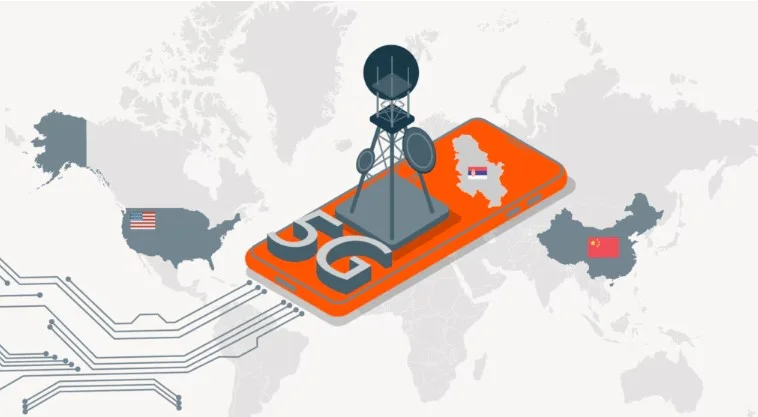
American Loans, European Equipment: Is Serbia Breaking Away from Chinese 5G Technology?
The 5G network being built by Serbia’s state-owned operator is currently based on equipment from European manufacturers. That is what Telekom Srbija told Radio Free Europe – a company that has worked with Chinese giant Huawei in recent years to develop telecommunications networks. Huawei is on the U.S. blacklist […]
The 5G network being built by Serbia’s state-owned operator is currently based on equipment from European manufacturers.
That is what Telekom Srbija told Radio Free Europe – a company that has worked with Chinese giant Huawei in recent years to develop telecommunications networks.
Huawei is on the U.S. blacklist, with the United States accusing the company of having equipment that could be used for espionage on behalf of the Chinese government.
The company has repeatedly denied these accusations.
The loan agreement Telekom Srbija signed in May with the U.S. Export-Import Bank (EXIM) to develop the 5G network is seen by Washington as an important step in limiting what it calls “malign influence by foreign actors.”
The agreement was also welcomed at the first round of the U.S.-Serbia Strategic Dialogue in mid-July.
In a joint statement, U.S. Secretary of State Marco Rubio and Serbian Foreign Minister Marko Đurić said that building the 5G network using “trusted vendors” would strengthen the security of communications systems in Serbia.
While Chinese companies are not considered trusted vendors by Washington, Telekom Srbija says the agreement with the U.S. bank contains no restrictive clauses regarding the choice of equipment suppliers.
The Serbian Ministry of Information and Telecommunications also says that choosing the companies that supply the network is a business decision for operators, not the state.
This comes as a number of Western countries have imposed restrictions or bans on Chinese companies, considering them a national security risk.
Serbian expert on geopolitics and security issues, Nikola Lunić, says that developing the 5G network puts Serbia to a strategic test.
“The question is whether Serbia belongs to the West’s security architecture, or whether it will remain a hub where Chinese and Russian interests intersect,” he told Radio Free Europe.
The U.S. State Department also stresses that critical technologies are safer when used only by trusted vendors.
“In cooperation with our partners and allies, we will continue to emphasize that the involvement or control of untrusted vendors, such as Huawei and ZTE, in 5G networks poses an unacceptable risk to national security, critical infrastructure, privacy, and human rights,” a State Department spokesperson told Radio Free Europe.
U.S. institutions have designated both Huawei and ZTE as national security threats – accusations that both companies have rejected.
Neither Huawei nor ZTE responded to Radio Free Europe’s questions.
Huawei has been involved for years in various projects in Serbia, including “smart city” and mass-surveillance systems.
These projects have raised concerns among some members of the public because of the use of facial-recognition technology and the risk of misuse of personal data.
Is Huawei withdrawing from cooperation with Telekom Srbija?
The rollout of 5G in Serbia began at the end of 2025, at a time when many Western countries had imposed restrictions or bans on the use of Huawei technology, citing national security concerns.
Today, the 5G network is operating in several Serbian cities.
It is being developed by state operator Telekom Srbija, as well as the two private operators, Yettel and A1.
Is Telekom Srbija moving away from Huawei?
Telekom Srbija has relied on Huawei equipment to develop previous generations of mobile networks.
In 2017, the state-owned company signed a strategic agreement with the Chinese giant to continue building broadband internet infrastructure.
The agreement for a $50 million loan guarantee with the U.S. Export-Import Bank (EXIM) raises the question of whether Telekom Srbija is joining the many Western companies that have reduced or ended their cooperation with Huawei.
Telekom Srbija did not directly answer this question.
The company told Radio Free Europe that its 5G network is currently based on equipment from Swedish company Ericsson and Finnish company Nokia.
It added that the agreement with the U.S. bank secures financing on favorable terms for projects using technology from American companies Juniper and Cisco.
“In the future, we plan to expand this agreement to include other American products that we use,” Telekom Srbija said, noting that it also has a similar financing agreement with the European Investment Bank.
The company did not confirm whether it, together with Serbia’s two other mobile operators, had committed to using only trusted vendors in developing the 5G network.
Such a commitment is mentioned in a report by the U.S. International Trade Administration, which says the EXIM agreement could mark a turning point in strengthening the position of American vendors in the Serbian market, as well as in limiting what Washington describes as “malign influence by foreign actors.”
Lunić says that, for the United States, the core 5G network is more than just telecommunications infrastructure.
“For the U.S., the core of the 5G network is also an element of control over the flow of data and, ultimately, over the ability of third parties to influence the operation of this infrastructure in a crisis,” he says.
In a report published in December 2025, the U.S. International Trade Administration assessed that Huawei has traditionally held a strong position in state-owned companies in Serbia, including Telekom Srbija.
The report also said that, in recent years, the other Chinese company, ZTE, had strengthened its presence in the market.
Who do the private operators work with?
Yettel, the second operator to receive a license from the Serbian regulator to offer 5G services, told Radio Free Europe that it is developing the network in partnership with Swedish company Ericsson.
The company emphasized that it has worked for years with major international technology companies and chooses its vendors based on performance, innovation, energy efficiency, and security standards.
Yettel is owned by the e& PPF Telecom Group, which has Czech and Arab capital.
The other private operator, A1 Serbia, did not respond to Radio Free Europe’s questions.
However, its parent company, A1 Telekom Austria Group, previously announced that it uses equipment from Nokia and Ericsson to develop its 5G network.
Serbia assesses 5G network risks
The Serbian Ministry of Information and Telecommunications told Radio Free Europe that operators providing 5G services choose their equipment suppliers themselves, in accordance with current legislation.
According to the ministry, a National Risk Assessment for the 5G Network is currently being prepared. Among other things, the document will classify equipment suppliers according to the level of risk they pose.
The ministry said this approach does not provide for the automatic exclusion of any company, but is based on risk assessment, a practice that, it says, is consistent with the approach of European Union member states.
It added that the degree of diversification of 5G equipment suppliers will also be assessed, with the aim of reducing dependence on a single manufacturer and increasing network resilience.
The Serbian ministry emphasized that, during this process, it is following international practices and recommendations, including those of the European Union and other partners.
However, geopolitics and security expert Lunić believes that the official messages and actions of the Serbian authorities are not always aligned.
“Statements about alignment with European practices are discourse intended for Brussels and Washington, while meetings with Huawei reflect a parallel reality aimed at maintaining relations with Beijing,” he says.
Lunić is referring to the meeting between Serbian Minister of Information and Telecommunications Boris Bratina and Huawei’s president for global government affairs, Tommy Zhou, in March, during the Mobile World Congress in Barcelona.
According to the ministry’s announcement, the meeting discussed the development of 5G networks and cooperation in smart cities, artificial intelligence, and cybersecurity.
“This kind of methodology, without coordination, is precisely what makes Serbia an unpredictable partner,” Lunić says.
“So Serbia is not choosing a side, but is trying to maintain both directions of cooperation at the same time,” he adds.
As a candidate country for European Union membership, Serbia is obliged to align its legislation with that of the EU.
The Law on Electronic Communications, adopted in 2023, introduced more detailed requirements for the security of electronic networks.
Two years later, Serbia also adopted a regulation setting out the obligations of operators and equipment suppliers regarding risk management, 5G network security, and supplier diversification.
Telekom Srbija told Radio Free Europe that, as it develops the 5G network, the company will seek to comply with the European Union’s guidelines and recommendations.
What do the European Union’s measures provide for?
To reduce risks related to the security of 5G networks, the European Union adopted a package of measures in 2020 known as the EU 5G Toolbox, which sets strict criteria for the selection and assessment of equipment suppliers.
Although the document does not directly name Chinese companies, in 2023 the European Commission officially identified Huawei and ZTE as suppliers posing a higher security risk than other 5G equipment manufacturers.
At the time, European Commissioner for the Internal Market Thierry Breton called on all member states to remove these companies from their national networks without delay.
Huawei described the call as a political decision and rejected claims that its technology poses a security risk.
So far, only a few European countries have fully completed the removal of Huawei and ZTE equipment from their networks, while most are still in the process of replacing it.
This process has proved costly and technically complex, so many countries have postponed their deadlines for completing it.
Obligation under the Washington Agreement
Serbia also undertook not to use 5G equipment from unverified suppliers under the 2020 Washington Agreement.
However, officials in Belgrade have said that the document does not explicitly prohibit the use of Chinese equipment.
That same year, the United States launched the “The Clean Network” initiative, aimed at protecting telecommunications networks from suppliers from countries that, according to Washington, do not respect digital privacy and human rights standards.
According to data from the U.S. State Department, more than 50 countries and over 180 telecommunications operators joined the initiative.
Unlike Kosovo, Albania, and North Macedonia, which have signed the Memorandum on 5G Network Security with the United States, Serbia has not officially joined the initiative.
Montenegro is not part of it either. The 5G network in that country is also being developed by Telekom Srbija, which owns the operator m:tel.
Bosnia and Herzegovina has also not joined the U.S. initiative, despite calls from the U.S. Embassy in Sarajevo.
It remains the only country in the Western Balkans that still does not have a commercial 5G network.
Continued cooperation with China
Chinese company Huawei continues to serve as a contractor, supplier, and partner of Serbian institutions in a range of projects.
During a meeting with Huawei representatives in July 2025, Serbian President Aleksandar Vučić singled out the company’s cooperation with the Ministry of the Interior (MUP) as significant.
Since 2017, Huawei has been working with Serbia’s Ministry of the Interior on the “Safe City” project, under which it has supplied around 1,000 surveillance cameras equipped with facial-recognition technology.
All information related to this project has been classified as a state secret.
China, alongside other countries, is also a partner of Belgrade in the development of artificial intelligence.
This was confirmed on July 16 in Shanghai, when Serbia signed an agreement with China to establish the World Artificial Intelligence Cooperation Organization (WAICO).
“Belgrade’s policy is sustainable as long as Western partners believe that the cost of tolerating it is lower than the cost of ending cooperation. But the terminology around ‘trusted vendors’ shows that this tolerance has its limits – and those limits are being tested right now,” Lunić says.
A total of 29 countries, including Russia and Belarus, signed the agreement to establish WAICO.














