The Antarctic Volcano That Scatters Gold Crystals, the Unusual Phenomenon of Mount Erebus
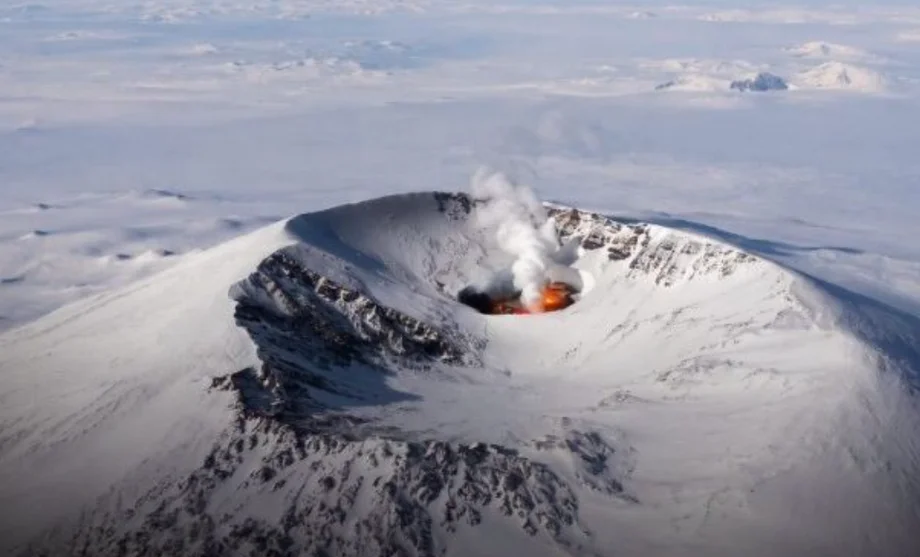
Mount Erebus is the southernmost active volcano on Earth, located on Ross Island in the Ross Sea, about 1,350 kilometers from the Geographic South Pole. It is also known for the presence of a permanent lava lake, a rare phenomenon on the planet. What makes Erebus unique and unusual is that it […]
Mount Erebus is the southernmost active volcano on Earth, located on Ross Island in the Ross Sea, about 1,350 kilometers from the Geographic South Pole. It is also known for the presence of a permanent lava lake, a rare phenomenon on the planet.
What makes Erebus unique and unusual is that it releases microscopic crystals of pure elemental gold into the atmosphere, a phenomenon that has not been identified at any other volcano in the world.
The discovery was first reported in a 1991 study published in the journal Geophysical Research Letters. According to this study, the volcano releases about 80 grams of microscopic gold dust every day, with particles that can be carried by winds up to 1,000 kilometers away, and potentially even farther.
A research team led by geochemist Kimberly Meeker of the New Mexico Institute of Mining and Technology analyzed Mount Erebus by collecting samples from the snow around the crater, gases rising above the lava lake, and the atmosphere of Antarctica as far as 1,000 kilometers away.
According to the results published in Geophysical Research Letters, all the samples contained small particles of pure gold. Electron microscope analyses showed that these were not irregular particles, but polyhedral crystals with regular, almost perfect geometric shapes. Some reached up to 60 micrometers in diameter.
The study also compared Erebus with other volcanoes. According to estimates at the time, Kilauea could release between 500 and 800 grams of gold per day, while Etna could release up to 2.4 kilograms per day. However, Erebus remains unique because it produces crystalline particles of elemental gold.
Scientists still do not have a definitive explanation for how these gold crystals form on Mount Erebus. The main question remains how gold separates from the compounds that transport it through the volcanic system.
One proposed model suggests that gold separates from the lava through volatile chlorine compounds. When these gases cool, the gold crystallizes and is then dispersed into the air before being deposited on Antarctic ice. However, this explanation has a problem: the concentration of gold in volcanic gases is too low to form such well-developed crystals.
According to ScienceAlert, volcanologist Philip Kyle, part of the research team from the New Mexico Institute of Mining and Technology, has proposed another hypothesis. According to it, gold may gradually form on the surface of the lava lake and then be lifted into the air by volcanic gases.
More than three decades after the initial discovery, the phenomenon remains not fully explained. Researchers emphasize that the combination of chemistry, extreme temperatures, geological conditions, and other unique factors in Antarctica may be the reason Mount Erebus is the only known volcano that produces and disperses gold crystals in this rare form.