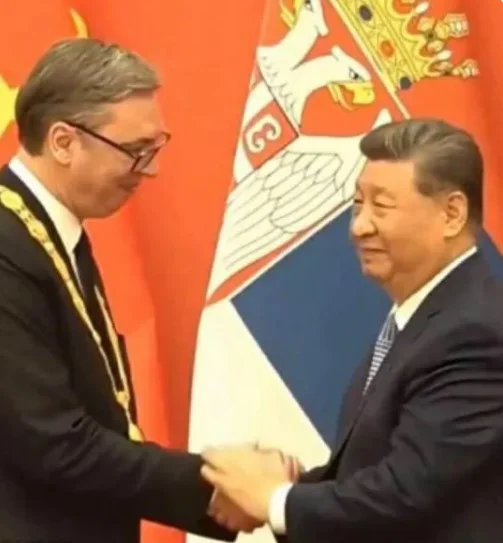
Serbia strengthens military ties with China despite pressure from the West
Serbia continues to arm itself with Chinese weapons. President Aleksandar Vučić announced on June 28, during a military exercise and display of Serbian Army equipment, that the country would buy additional CM-400 supersonic ballistic missiles, as well as new military aircraft. Vučić described the CM-400 missiles as “fearsome missiles” and said that […]
Serbia continues to arm itself with Chinese weapons. President Aleksandar Vučić announced on June 28, during a military exercise and display of Serbian Army equipment, that the country would buy additional CM-400 supersonic ballistic missiles, as well as new military aircraft.
Vučić described the CM-400 missiles as “fearsome missiles” and said Serbia would increase their number.
Katarina Đokić, a researcher at the Stockholm International Peace Research Institute (SIPRI), told Radio Free Europe that the announcement suggests that the new fighter aircraft will also be purchased from China, KosovaPress reports.
“It makes no sense to buy such expensive missiles for aircraft that will soon no longer be usable,” she said.
Vučić first confirmed in March that Serbia had bought missiles from China, but Serbian authorities have not yet disclosed their price or quantity.
According to international arms registers, Serbia is the only country in Europe to possess CM-400 missiles, while China is its largest military supplier.
The purchase of weapons from China is part of the strengthening of relations between Beijing and Belgrade, which officials from both countries have described as a “steel friendship.”
The European Union and the United States have repeatedly warned Serbia about the risks of deepening military cooperation with China, particularly given that Serbia is an EU candidate country.
“A credible alternative”
According to Đokić, there are several reasons why Serbia turns to China for arms supplies.
“China presents itself as a credible alternative, especially considering that its arms are cheaper than Western ones,” she said.
Đokić added that there are also political reasons why Serbia cannot buy more advanced weapons systems from the United States, one of the world’s largest arms exporters.
“Since Serbia is not a NATO member, it is not considered a reliable partner by the United States. When it comes to more sophisticated systems, such as fighter aircraft or air-defense systems, the United States sells them to its partners,” Đokić explained.
According to her, Chinese weapons have been developed based on the Soviet weapons model, which Serbia already possesses, so they are “not difficult to integrate” into its existing arsenal.
In addition to the missiles, the Serbian Army also received Chinese CH-92A drones in 2020.
This was the first purchase of weapons from China to be incorporated into the combat capabilities of the Serbian armed forces.
Serbia subsequently also bought CH-95 combat drones, as well as Chinese FK-3 and HQ-17 air-defense systems.
Cooperation continues despite warnings
Serbia’s purchases of Chinese weapons have not gone without reaction.
In June, the European Parliament’s Committee on Foreign Affairs (AFET) strongly condemned the purchase of Chinese CM-400 missiles, saying that such a move runs counter to the European Union’s common policy.
According to the document adopted by the committee, the purchase “raises serious questions about Serbia’s geopolitical orientation.”
Meanwhile, at a December 2025 hearing of the U.S. House Foreign Affairs Committee on the Western Balkans, it was stated that Russia and China are contributing to increased instability in the region.
Republican Congressman Keith Self said that China is expanding its influence through military exercises and by supplying Serbia with weapons.
Serbian foreign policy analyst Boško Jakšić believes that the purchase of Chinese weapons is a strong political message at a time when the United States and the European Union expect Serbia to scale back its relations with China and Russia.
“This contradicts what Serbia officially declares, namely its commitment to integration into the European Union,” Jakšić told Radio Free Europe.
A message to the region
Vučić’s announcement in March that Serbia had bought Chinese CM-400 missiles also sparked concern in the region.
Croatian Prime Minister Andrej Plenković said at the time that Zagreb would discuss the development with its NATO allies.
“We will speak with our partners in the North Atlantic Alliance and warn them about this type of weaponry, which is a new addition to the Serbian Army’s arsenal,” Plenković said.
Vučić responded by saying that “Zagreb will not decide what weapons Serbia will have.”
He also claimed that Serbia was preparing for an attack by “the alliance being formed by Pristina, Tirana and Zagreb.”
In March 2025, Kosovo, Albania and Croatia—the latter two NATO member countries—signed a declaration on cooperation in the field of defense and security.
Serbian officials described the agreement as a threat to Serbia’s security, while the signatories rejected these claims.
Vučić said at the time that Chinese CM-400 missiles have a range of 200 to 400 kilometers and described them as weapons with great destructive power.
Đokić said that reactions from countries in the region to these purchases were not unexpected, given that it remains unclear “what Serbia intends to achieve” with these weapons.
“All of this is consistent with a policy of irrational spending. With our money, Vučić is buying political support from Beijing and Paris all the way to Moscow,” Jakšić said.
During the weapons display on June 28, Vučić told reporters that the Serbian Army possesses Chinese, American, Russian, French and Serbian missiles.
Data show that Serbia continues to buy weapons from various sources, but in recent years Chinese weapons have taken the leading place in the country’s military imports.
According to data from the Stockholm International Peace Research Institute (SIPRI), France is Serbia’s second-largest arms supplier, accounting for 12 percent of imports, while Russia is third, with 7 percent.
One of Serbia’s largest military purchases is the acquisition of 12 Rafale fighter aircraft from France, worth 2.7 billion euros.
From Russia, Serbia has bought used MiG-29 fighter aircraft, helicopters, the Pantsir-S1 air-defense system, as well as Kornet anti-tank missiles.
Increased defense spending
According to SIPRI data for 2025, Serbia allocates more funding to its military than any other Western Balkan country, most of which are NATO members.
According to Đokić, Serbia’s defense spending has been steadily increasing since 2017, but the reasons for this are not entirely clear.
She said Serbia’s strategic defense documents do not clearly define the threats facing the country.
“On the one hand, it was expected that the military arsenal would be upgraded at some point. But on the other hand, we do not have a clear explanation of what this weaponry will be used for,” Đokić said.
Serbian officials have stated on several occasions that Serbia has no intention of attacking anyone.
Đokić noted that increased defense spending is a trend seen throughout Europe, but with clearer motives.
She said that in some countries, perceptions of the threat posed by Russia have intensified, especially since the full-scale invasion of Ukraine began in 2022.
“When it comes to NATO member countries, there is also pressure from the Alliance to increase military spending and demonstrate commitment to it,” Đokić said.
Serbia has been part of NATO’s Partnership for Peace program since 2006, but continues to declare its adherence to a policy of military neutrality.