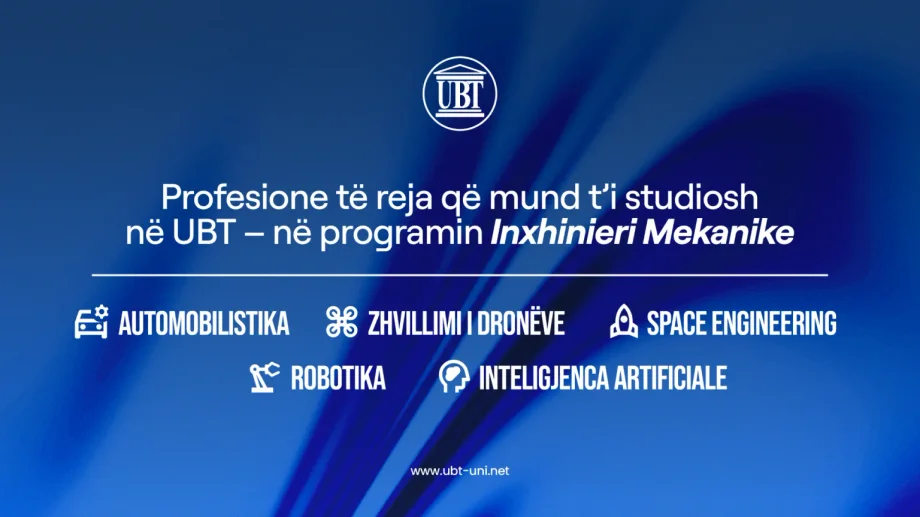
Automotive engineering, drone development, robotics and space engineering: new professions you can study at UBT
Automotive engineering, electric vehicles, robotics, drones, artificial intelligence, smart manufacturing and space technologies are no longer just topics of the future. At UBT, these fields are becoming part of a modern Mechanical Engineering program, offering young people in Kosovo the opportunity to prepare for the professions and industries that are changing the world.
The Bachelor of Science program in Mechanical Engineering at UBT combines a strong engineering foundation with modern technologies and opportunities to specialize in fields that are transforming global industry.
For the first time, automotive engineering is one of the specialization tracks
One of the most attractive elements for the new generation of students is Automotive Engineering.
Rather than viewing automotive engineering solely as traditional mechanics, students learn about new developments in the automotive industry and the technologies changing how vehicles are designed, manufactured and used.
Through this concentration, students can pursue fields such as:
- Vehicle Dynamics;
- Vehicle Systems;
- Hybrid and Electric Vehicles;
- Vehicle Maintenance and Diagnostics;
- Transport Safety and Standards.
This makes automotive engineering one of the most interesting opportunities for young people who see themselves in the next-generation automotive industry – from electric vehicles to intelligent transport systems.
From the idea of a drone to Aeronautical Engineering
Another field that may particularly appeal to young people is Aeronautical Engineering.
Students can explore fields such as aerodynamics, flight dynamics, aircraft structures and materials, propulsion and power systems, fatigue and fracture mechanics, as well as unmanned aerial vehicles – drones.
This means that a student passionate about aviation technology no longer needs to see this field as something that belongs only to foreign industries.
From designing a flying structure to developing systems for unmanned aerial vehicles, aeronautics can become part of their academic journey in Kosovo.
The next step: space technologies and Space Engineering
Knowledge of aerodynamics, materials, propulsion systems, mechanics, automation and aerial vehicles provides a foundation for pursuing advanced fields such as Space Engineering and technologies related to space exploration and systems.
For a generation that has grown up with satellites, space missions, reusable rockets and autonomous technologies, this represents an opportunity to see engineering from an entirely different perspective.
From designing a mechanical component to systems that must operate under extreme conditions – space engineering begins with a solid engineering foundation.
Robots, artificial intelligence and smart factories
The Smart Manufacturing concentration guides students toward technologies such as:
- Industrial robots;
- Smart factories and IoT in industry;
- Artificial Intelligence in manufacturing systems;
- Additive manufacturing technologies;
- Predictive maintenance and condition monitoring.
Students are prepared not only to understand how a machine works, but also how machines can communicate, be automated and operate in integrated systems.
One of the most important components of the program is its practical focus.
The laboratories offer opportunities to work with advanced manufacturing and automation systems, including flexible manufacturing systems, PLCs, pneumatics and electro-pneumatics, sensors, measurement systems, AC motors, robotics and other technologies used in industry.
Students can learn through projects, experiments, simulations, laboratory work and professional practice, connecting the theory learned in the classroom with real-world industry challenges.
This is an important change in how engineering studies can be experienced:
- less theory disconnected from reality and more opportunities to design, build, test and improve.
Five pathways, one profession of the future
The program gives students the opportunity to specialize in different fields of Mechanical Engineering during their studies:
- Design and Manufacturing Engineering
For those who want to design products and work with CAD/CAM, CNC, finite element methods and modern manufacturing technologies.
- Thermo-Energy Engineering and Renewable Energy
For students who want to work with the energy of the future, heating, ventilation and air-conditioning systems, energy efficiency and sustainable development.
- Smart Manufacturing
For those who want to work with robots, AI, IoT, automation and smart factories.
- Automotive Engineering
For enthusiasts of automotive engineering, electric and hybrid vehicles, vehicle systems and transport technologies.
- Aeronautical Engineering
For those who dream of aircraft, drones, aerodynamics and aviation technologies.
The Bachelor of Science in Mechanical Engineering program is offered at NQF Level 6 and comprises 180 ECTS, with a study structure that combines fundamental engineering courses with industry-oriented specializations.
During their studies, students engage with mathematics, physics, mechanics, materials science, CAD/CAM, thermodynamics, electrical and electronic engineering, manufacturing, mechatronic systems, automation and project management – before specializing in their preferred field.
This creates a broad professional profile: an engineer who understands mechanics, technology, manufacturing and modern systems.
Industry is looking for professionals who know how to think beyond a single discipline.