
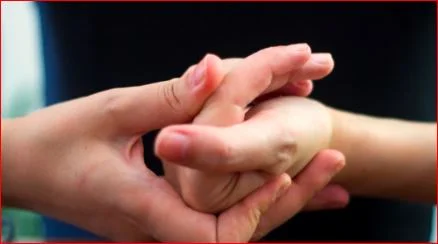
Should you stop cracking your neck and fingers?
For some people, cracking their fingers is simply an unconscious habit. Others enjoy the sensation that comes from cracking their joints. Judging by the many chiropractic manipulation videos that have become popular on social media, it seems that many people also enjoy hearing that “crack”. In fact, what happens […]
For some people, cracking their fingers is simply an unconscious habit. Others enjoy the sensation that comes from cracking their joints. Judging by the many chiropractic manipulation videos that have become popular on social media, it seems that many people also enjoy hearing that “crack”.
In fact, what happens when we crack our joints is relatively simple.
A joint is where two bones meet, and the joints in the fingers, neck and back are surrounded by synovial fluid, an egg-white-like substance that acts as a lubricant.
When we twist, pull or bend a joint to crack it, the space inside it temporarily expands. This causes the pressure of the synovial fluid to drop and, as a result, gases that were previously dissolved in the fluid begin to form bubbles, the BBC reports.
The sound of a joint cracking, which is actually related to the formation and changes of these gas bubbles, can be surprisingly loud, reaching up to 83 decibels. That is roughly as loud as a diesel-engine truck passing nearby at around 64 km/h.
When scientists at the University of California, Davis, observed a joint being cracked using ultrasound, they described the moment of the “crack” as something that looked on screen like a firework exploding.
A mostly harmless habit
It can be noisy, but the sound of joints cracking is “just a normal physiological process”, says Kimme Hyrich, a rheumatologist at the University of Manchester in the UK.
But does “normal” necessarily mean “harmless” too?
“Of course, there are some warning signs, such as joint pain or swelling,” says Jay Jagannathan, a neurosurgeon from Michigan in the US. He has treated patients with sprains and other problems after they cracked their necks with excessive force, something that is not recommended.
However, in general, when you feel the urge to crack your joints, it is considered fairly harmless, Jagannathan says.
Some people are still concerned that forceful finger-cracking could cause a finger to dislocate or damage tendons, especially when a lot of force is used or when the finger is suddenly pulled in a way that could accidentally dislocate it.
And indeed, there have been a few such cases. In 1999, for example, a hand surgeon from Philadelphia described cases of two patients who sprained their fingers because they had tried too hard to hear that satisfying cracking sound.
But when cracking is done with less force, such cases are rare.
Does cracking your fingers cause arthritis?
However, the main concern of people who regularly crack their joints is whether they will one day develop osteoarthritis – the most common type of arthritis, associated with the wearing away of cartilage, the protective tissue that cushions the bones in a joint.
“It’s something a lot of people ask me about in the clinic and also during conversations around the dinner table,” says Hyrich.
“The simple answer is: no,” she says.
Several studies have debunked this old myth.
When he was young, Donald Unger was warned by his mother, several aunts and later his mother-in-law that constantly cracking his fingers would give him arthritis. Determined to prove them wrong, he cracked the joints in his left hand at least twice a day for 50 years – around 36,500 cracks in total – while leaving his right hand untouched.
In 1998, at the age of 72, he had X-rays taken of both hands to see the result of his lifelong experiment. “There was no arthritis in either hand and there were no noticeable differences between them,” he concluded.
Be careful with your neck
While cracking your fingers is unlikely to be a problem, the same is not true of cracking your back and neck.
The neck contains important nerves, including the spinal cord.
“In addition, two very important arteries run through there, at the back of the neck, and go up to the brain,” Jagannathan adds.
These areas are delicate, and manipulating them incorrectly can cause serious injuries and side effects, such as numbness or tingling in the limbs and dizziness.
“Any kind of excessive manipulation is dangerous,” says Jagannathan.
Forcefully cracking your own neck is not recommended, while even professional neck manipulations are a subject of debate.
In 2012, Neil O’Connell from the Centre for Research and Rehabilitation at Brunel University and his colleagues described chiropractic neck manipulations as “unnecessary and inappropriate”.
Why do some people feel better after cracking their joints?
For some people, cracking can bring a sense of relief and a temporary increase in joint mobility, because it stretches the joint and takes it through a greater range of motion.
One theory even suggests that cracking stimulates the nerve endings around the joint, relaxing the surrounding muscles, while it may also reduce pain and release endorphins, but this theory has not yet been proven.
Since cracking your fingers is mostly harmless, there may be no compelling reason to stop.














