From a lack of grants to market challenges, women entrepreneurs seek more support
Women entrepreneurs in Kosovo continue to face numerous challenges in developing their businesses. Some say they have received support for promotion and participation in trade fairs, while others say they have never benefited from institutional support, despite applying repeatedly. They are calling for more financial support and better […]
Women entrepreneurs in Kosovo continue to face numerous challenges in developing their businesses. Some say they have received support for promotion and participation in trade fairs, while others say they have never benefited from institutional support, despite applying repeatedly. They are calling for more financial support and more favorable conditions for developing their businesses.
Sanije Hyseni, who sells antique silver and precious stones, told Ekonomia Online that they are pinning their hopes on the Ministry of Industry, Trade, Entrepreneurship and Innovation.
“I deal in antique silver that is more than 50–60 years old, and I focus especially on stones, those that bring positive energy to people or affect their health. For example, I also deal in precious stones, such as emeralds, turquoise, amethyst, and so on. If we start with astrology, it depends on the month they were born and that affects positive energy or mood. Certainly, yes. Mimoza Kusari-Lila told us that we would try by every means to help you and also secure opportunities for other places abroad to participate,” Hyseni said.
However, she stressed that businesswomen need more space and better conditions to carry out their activities.
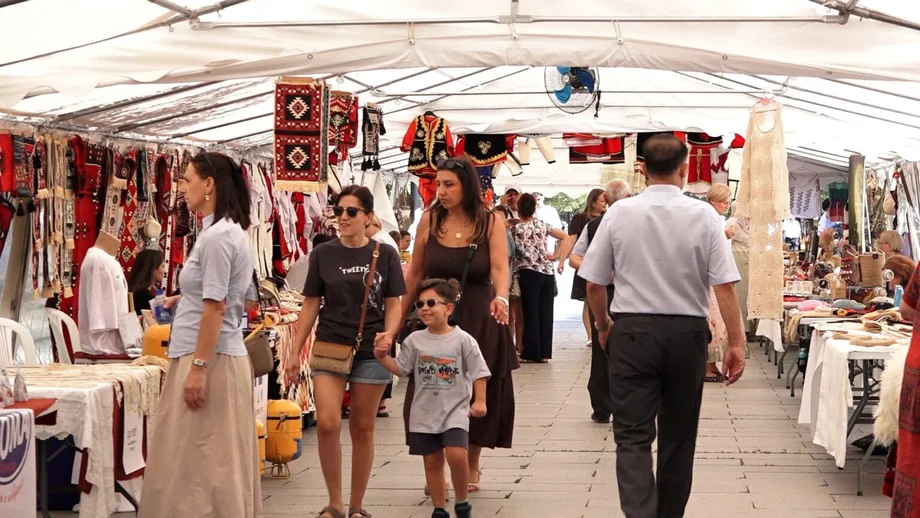
“For example, finding a location, because this year everything was taken up either by little houses or by drinks, since everyone has their own. Women, though, are at a bit of a disadvantage,” she said.
Speaking about the challenges women face in business, Hyseni said that many of them bear the main economic burden of their families.
“It means a lot, because perhaps the whole household is unemployed, and her entire life, the whole livelihood, depends on her. Some work with traditional clothing, others work with these looms; that is hard work and costs a lot. For them, any help at all—a place being assigned to them, or at least a kiosk or a small shop, or grants and subsidies so they can develop—would be helpful,” she said.
Meanwhile, Blerta Muja, founder of the “House of Japan” concept, told Ekonomia Online that for a new business, the greatest support comes through promotion and creating opportunities to showcase its products.
“First, I want to say that for me this is a form of support, because it is a very new concept that requires public awareness, so I see this as a very good opportunity to show the products we make. In the long term, I see support in the form of grants, for example, and subsidies, because the aim is to expand production and establish a manufacturing facility, and that naturally requires financial resources,” Muja said.
In her view, the trend in support for women in business is positive.
“In my opinion, at the moment things seem to be going well. The aim is there, the willingness is there, and, as I said, we also heard some figures showing that women’s employment in Kosovo is increasing, so I think we are on the right track,” she said.
Meanwhile, Havushe Bunjaku, owner of the “99 Lule” business, told Ekonomia Online that despite her business being established in 2010 and holding certification, it has received no support from institutions.
“As a business established in 2010, registered, licensed and organically certified, we have never received support from the government or ministries, even though we have applied many times. The business has, however, had projects; we have implemented many projects in partnership with various international organizations. Trade fairs are good; we connect with consumers even though we have been in the market for many years. But when we develop new products, we present them at trade fairs here too, so that has its own value. Women’s businesses need a great deal of support,” she said.
Bunjaku stressed that the challenges are not limited to establishing a business, but continue as it develops.
“I have a long experience in this sector. I have now spent 16 years working exclusively in the same sector: aromatic medicinal plants and wild berries, which we gather, and some of which we also cultivate. I have more than 50 women under contract whose products I buy. Starting a business is difficult, but then it is difficult to sustain it along the way, and it is also difficult to develop it, because the problem then is the market and getting products onto the market. For us, as products, and for Kosovo as a new country, and for women who do not have much capital to invest all at once and establish themselves in the market and gain access to it, this is a very big problem in Kosovo,” she said.
According to her, supporting women entrepreneurs would benefit not just one business, but help create a broader economic chain.
“The market needs to be balanced. Local producers should be given the opportunity to bring their businesses’ products to market. Women and women-owned businesses should be supported. Sustainable businesses should be supported, because it is not just one woman who starts a business; then I have other women as well. Besides developing herself, a woman generates income for her family, and she also gives another woman a helping hand. Given that “99 Lule” has had a very significant impact in this sector, I am the first woman to have registered a business of this kind in aromatic medicinal plants (because previously only men owned these businesses, while women worked on farms). As the first woman, I also encouraged other women to start working in this business. Today I am very pleased, and I can say that, following my example, I know and often meet women who have started working in the same worthwhile field,” Bunjaku added.