
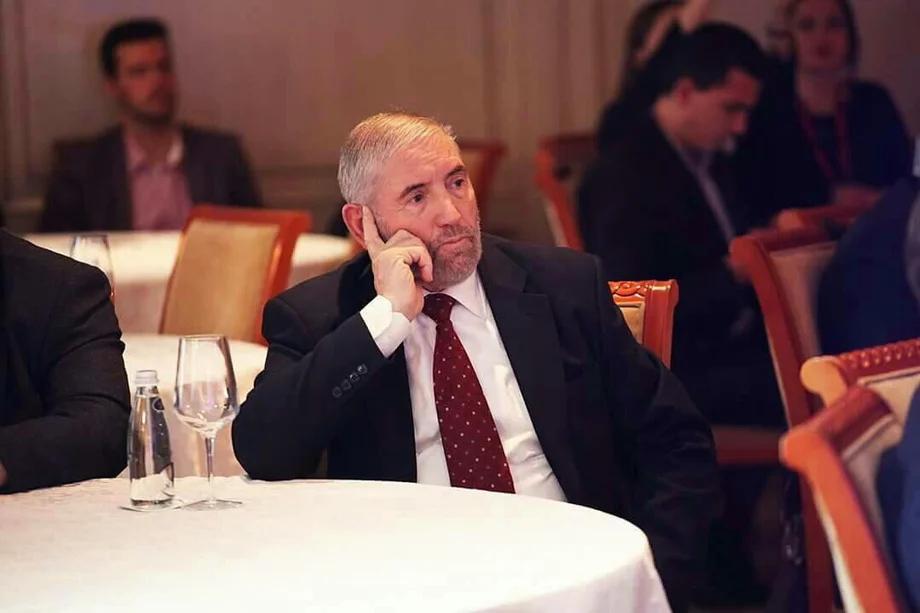
REXHEP BOJA — A LIFE OF SERVICE TO KOSOVO
On the fifth anniversary of the death of Dr. Rexhep Boja, our memory takes us back not only to a mufti, professor or ambassador. It takes us back to an era. It takes us back to a generation of men who grew up with Kosovo as a wound and experienced its freedom as a trust; to people who did not see position as a privilege, did not keep knowledge to themselves, and did not turn authority into personal glory, but into a means of serving their country. Dr. Rexhep Boja had his place in this generation.
On the fifth anniversary of the death of Dr. Rexhep Boja, our memory takes us back not only to a mufti, professor or ambassador. It takes us back to an era. It takes us back to a generation of men who grew up with Kosovo as a wound and experienced its freedom as a trust; to people who did not see position as a privilege, did not keep knowledge to themselves, and did not turn authority into personal glory, but into a means of serving their country. Dr. Rexhep Boja had his place in this generation.
He did not enter the national currents of the 1990s by chance. His national consciousness preceded his institutional position. Born in Kërrnicë, in the municipality of Klina, into the Boja family line, the family of the guerrilla fighter Feriz Boja, and in an environment where the memory of Albanian resistance was alive, he grew up in a horizon where religion, nation, knowledge and duty to the country were not separate worlds.
When he left Kosovo for his education, he did not leave in order to break away from it.
He left to be educated — so that one day he could return to it prepared.
His path of education took him to Damascus. In 1967, the young Rexhep Boja arrived in one of the most important centers of the Arab world. There he found not only schooling and religious studies. He also found an Albanian world in exile, but not one that had surrendered: scholars, teachers, intellectuals and men from Kosovo who had taken with them, far from their homeland, the memory of an occupied country and the hope for a free Albania and Kosovo.
In that environment, he became particularly close to Kosovar patriots such as Ismail Gorani and the scholar Abdulkadir Arnauti, men of a generation who had paid for their loyalty to the Albanian cause with exile, persecution and sacrifice.
Thus, for Rexhep Boja, Damascus was not merely an address for education. It was a second universe of formation: a place where religious knowledge met national consciousness, where the memory of Kosovo was preserved far from it. Boja himself described Damascus as a place that had “a special place in my heart.” An Albanian exile in the East was not simply someone who had changed their place of residence. In many of those families lived the memory of displacement, the loss of a birthplace and the effort to preserve their origins. Rexhep Boja, who had come from Kosovo, found himself among Albanians who saw Kosovo from afar — and it was precisely that distance that had made it even dearer to them. A special testament to Dr. Rexhep Boja’s early patriotic formation was also an old manuscript of “The Highland Lute”, which, during his stay in Damascus, one of the Albanian patriots had given him. To him, it was not simply a book kept as a memento. It was a piece of Albania that accompanied him far from home. Boja knew whole passages of “The Highland Lute” by heart; he remembered the song of Oso Kuka with particular emotion. In those verses he found what would characterize him throughout his life: loyalty, manliness, resistance and an unconditional love of the homeland. It was as if, even then, two pillars that would accompany him throughout his life were living together in his young soul: faith in God and love for the nation.
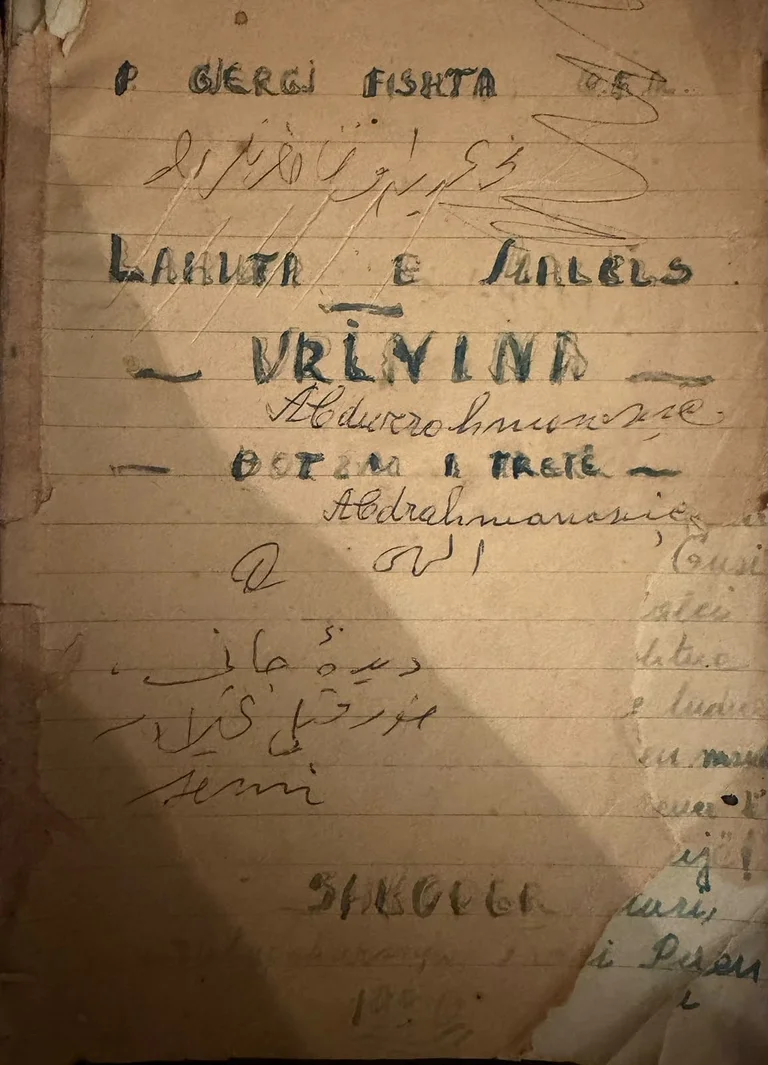
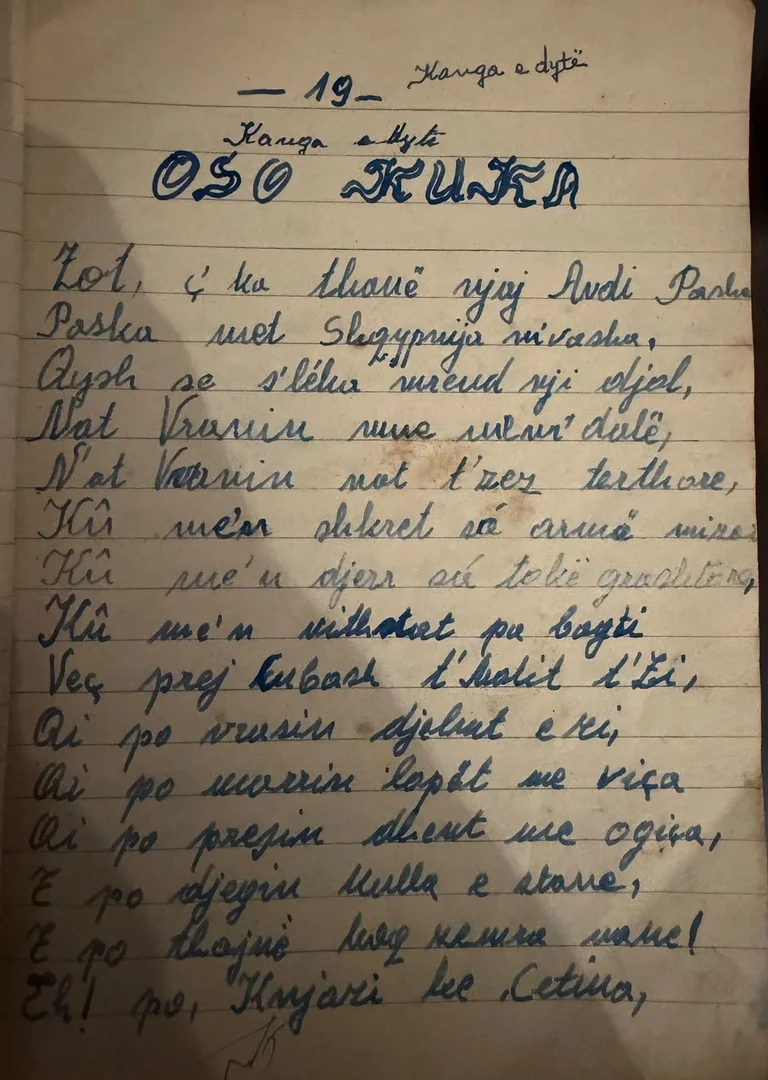
This manuscript, received from the hands of Albanian patriots, would later take on a particularly symbolic meaning. Rexhep Boja might have been far from Kosovo, but he carried Kosovo and Albanian identity with him — in his mind, in his heart and, as that old “Lahuta” also testifies, in his student bag. And many years later, when it came time to show what his homeland meant to him, he would prove it with his life, as if reciting the verses of “The Highland Lute.”
The path to knowledge was not easy. During his stay in Damascus, Rexhep Boja faced persecution by the Yugoslav regime, which extended even through diplomatic channels. For this reason, he was forced to leave Syria secretly. With the help of Albanian friends, he crossed through Jordan and, after a difficult journey, reached Saudi Arabia, where he settled in Medina. It was there that he decided to continue his education and deepen his knowledge of Islam.
But Medina was not merely a distant city where he was given the opportunity to study. It was the birthplace of the Prophet Muhammad, peace be upon him, the city of the Hijra, of knowledge and faith. Living and studying there had a special significance. In that land, where the Messenger of Allah had lived and worked, and where he rests, even his daily life as a student took on a deeper meaning. Studying in Medina, then, was not only a stage in his academic formation. It was an experience that intertwined knowledge with faith, student life with spiritual experience, and intellectual inquiry with proximity to the places where the early history of Islam had taken shape.
In Medina’s harsh heat, amid high temperatures, long days and conditions that demanded patience and adaptation, he devoted the best years of his youth to knowledge.
The more difficult the path became, the greater his determination to continue seemed.
His thirst for knowledge was greater than fatigue, stronger than distance and more enduring than any hardship.
In that blessed city, far from Kosovo, he was slowly laying the foundations of an entire life.
Medina also gave him something else: a deep spiritual connection with a place he would always carry in his heart. It was precisely in those years that one of Rexhep Boja’s greatest qualities was forged: the ability to stand up to hardship without losing sight of his purpose.
In the heat of Medina, in the city of the Prophet, a young Albanian was patiently forging the most powerful weapon he would one day need to serve his country: knowledge.
The years passed and, step by step, he earned a master’s degree, then the highest academic degree, a doctorate. He became the first Albanian doctor to study the Islamic faith.
During the years of his education and studies, Rexhep Boja met and got to know people from various parts of the Islamic world: students, professors, scholars, intellectuals and public figures. Over the years, some of them would attain important positions in the religious, academic and state institutions of their countries.
Perhaps in those years no one could have known that these youthful acquaintances would one day take on extraordinary value. But Boja did not forget them. He maintained them, cultivated them and kept them alive.
The friendships he formed in scholarly circles and in everyday life in the Arab world would, over time, become a network of trust, respect and friendship, which he would expand throughout his life. This was his capital of human relationships. Rexhep Boja learned not only from books. He also learned about people, cultures and societies. He learned the language of an entire world and understood the importance of bridges built between people.
He did not build those connections for himself alone. Over the years, he would turn them into bridges for Kosovo. People he had known as students, professors or contemporaries would later find themselves in high positions. And when Kosovo needed to knock on the doors of the Arab world, Boja would have doors open to him.
Behind many of those doors were people who had known him for years, valued his knowledge, trusted his word and understood his concern for Kosovo.
Thus, the years in Medina gave him two great riches: the knowledge he carried in his mind and the people he held in his heart. He would turn one into institutions and education; the other into friendships. Many years later, when Kosovo needed friends, connections and a voice of its own in the Arab world, those early relationships would take on a new meaning.
Therefore, when Rexhep Boja left Medina to return to Kosovo, he took with him not only his degrees and the knowledge he had acquired. He took the memory of the city of the Prophet, the experience of an entire world and a circle of people whom history would once again place in his path.
And then came the decision that, perhaps better than any words, explains his character: he returned.
In 1986, Rexhep Boja returned to Kosovo. He could have stayed in a place where he had made connections, where he knew the language, culture and institutions, and where his academic education could have secured him a comfortable career.
But he chose Kosovo. He chose to return to a country entering years of intense political pressure. He returned with a rare asset at the time: knowledge, a doctorate, the Arabic language, experience, contacts and credibility in circles where Kosovo had virtually no voice.
That is why Rexhep Boja’s return should be seen as bringing knowledge back to the homeland.
He initially served as an imam in Peja and as a lecturer at the “Alauddin” Madrasah in Pristina. Later, on the eve of the decisive decade for Kosovo, Rexhep Boja took over the leadership of the Islamic Community of Kosovo. He did not take over the institution simply to administer it. He took the institution from the hands of a leadership structure that had operated within the framework of the Yugoslav system and which, in the conditions of the time, was connected to that system’s institutional order. With Boja’s appointment as head, a powerful shift in the institution’s orientation began. He increasingly detached the Islamic Community from the spirit of submission to the old structures and set it on the path of institutional independence, in step with the major national developments sweeping Kosovo. He took over the institution to turn it into one that would move forward with its own people. At that time, as Albanians were leaving the imposed structures of the Yugoslav system and building their own independent institutions, Boja was clear that the Islamic Community had to break free from every grip of the Yugoslav Serb system. He oriented the institution toward those who had made Kosovo’s autonomy, freedom and liberation the foundation of their national mission. Thus, his leadership was not simply a change of name at the head of a religious institution. It was a change of course. From an institution embedded in Yugoslavia’s institutional architecture, he built an Albanian, independent institution, accountable to the historical moment Kosovo was experiencing. Rexhep Boja did not wait for history to change the institution. He changed the institution’s direction so it could join the history of its own people.
The process would culminate in December 1993, when the Islamic Community of Kosovo broke away from the Yugoslav Riyasat and declared its independence. Rexhep Boja did not wait for history to change the institution. He changed the institution’s direction so it could join the history of its own people. From that moment on, the Islamic Community under his leadership would increasingly become part of the infrastructure of Albanian resistance: of education, social organization, the defense of rights, reconciliation and the struggle for freedom. Under his leadership, he opened the ICK institution, and when Albanian students were expelled from dormitories, the Madrasah became a refuge for them. When a political, cultural or academic gathering had to be held, the ICK institutions provided space for it. When Albanian-language education was expelled from state buildings, mosques also became, among other things, places of learning.
When Albanian society needed infrastructure to survive outside the Serbian system, the Islamic Community made what it had available. Under his leadership and responsibility, more than 1,200 gatherings, events and political, cultural and academic activities were organized in the buildings of the ICK institutions.
In the harshest years of Serbian repression, when Kosovo was under enormous pressure and crimes against the Albanian population had to be documented before their traces disappeared, the Council for the Defense of Human Rights and Freedoms became one of the important institutions documenting violence in Kosovo.
And it was precisely at that time that Rexhep Boja opened the doors of the institutions he led.
For a period, the CDHRF carried out its activities in the premises of the Faculty of Islamic Studies, in space made available by the institution led by Boja. There, testimonies of arrests, torture, killings, expulsions and other forms of repression against the Albanians of Kosovo were gathered and documented.
This was not simply institutional hospitality. At a time when the Serbian regime was trying to conceal the violence and shut Kosovo off from the eyes of the world, Boja gave space to an institution that was turning the suffering of the people into testimony, and testimony into an argument before the world. But his contribution did not end with providing physical space.
If the CDHRF, from Pristina, was showing the Western world what was happening in Kosovo, Rexhep Boja was making a similar effort in another direction: taking that voice to the Islamic world.
He had the language, education, authority and connections he had built during his long years in the Arab world. In countries where Kosovo had less of a voice, he could speak directly with scholars, intellectuals, religious leaders and public figures.
He told them what was happening to the Albanians of Kosovo. He spoke about Serbian repression and called on the Islamic world not to remain indifferent in the face of the tragedy of a people fighting for freedom. Thus, in a particular way, two voices emerged from the same space and reached out to two different worlds.
The CDHRF gathered evidence of violence and conveyed it to Western public opinion and institutions.
Rexhep Boja, with his religious, intellectual and human authority, conveyed the same message to the Islamic world.
In this sense, the premises of the ICK and the Faculty of Islamic Studies were not merely spaces belonging to a religious institution. During the years of repression, they became places where Albanian testimony, knowledge and resistance came together.
Rexhep Boja knew that the struggle for Kosovo was not waged only in the streets, at demonstrations or on the fronts of resistance. It was also waged on another, quieter but equally important front: the battle to win the world’s attention and show it the truth about Kosovo.
In 1993, another act of great significance took place: the Islamic Community of Kosovo’s independence from the Riyasat of the Yugoslav system. This act was part of the general spirit of the time. The Islamic Community’s independence was part of this broader process of institutional liberation. But for Boja, independence was not enough. An independent institution needed people prepared to carry that independence on their shoulders.
It was precisely for this reason that Boja devoted extraordinary attention to higher Islamic education in Kosovo.
The Faculty of Islamic Studies, established by a decision of the ICK Assembly on 15 August 1992 and beginning its work in the 1992/93 academic year, was a response to a profound need of the time. He was firmly convinced that Albanian students should no longer have to leave the country to receive an advanced education in Islamic sciences. They could study in Kosovo, in the Albanian language, within their own social and cultural environment, and at the same time be part of a broad tradition of Islamic knowledge.
This was far more than the opening of a faculty.
It was the building of a school for a society that was building its own future.
The FIS premises were not merely preparing people for religious service. A generation was being built that would carry Islamic knowledge in the Albanian language and within the Albanian reality of Kosovo; a generation that could serve in mosques, educational institutions, academic life and the public life of the country.
This was one of Boja’s most important ideas: Independence is maintained not by declarations alone; it is sustained by institutions and by people prepared to lead them.
Beyond Kosovo, another dimension of Rexhep Boja was becoming increasingly important. The Arab world was a place he knew. He knew the language. He knew the cultural codes. He knew the scholars. He knew the institutions. People knew him.
But he did not treat all this capital, accumulated during his youthful years, as a personal asset.
He preserved it, expanded it and, whenever Kosovo needed a door in the Arab world, tried to open it in the name of his country.
In the years when the country was deprived of state representation and Kosovo had no opportunity to speak directly at international tables, Boja became one of the voices carrying the Kosovo issue beyond its borders.
His position as leader of the Islamic Community gave him an international platform that few Kosovo Albanians had at the time. He took part in important conferences, symposia and meetings of the Islamic world and, according to his biographies, in more than 150 international conferences, symposia and meetings.
At international forums where religion, peace, human rights and developments in the Islamic world were discussed, he turned attention to Kosovo. He spoke about Serbian repression, violence against Albanians, the closure of institutions, expulsions, violations of fundamental rights and the right of the people of Kosovo to live freely and decide their own future.
In the absence of a state that could speak on Kosovo’s behalf, he tried to do so; he used the platforms. In the absence of diplomats, he used his authority. In the absence of a state that could speak on Kosovo’s behalf, he tried to make Kosovo’s voice heard.
This required more than a good speech. It required relationships. It required trust.
It required knowing the language and political culture of the countries where he spoke.
And it was precisely here that the full value of the capital Rexhep Boja had built during his years of formation in the Arab world became apparent. He had built bridges long before Kosovo needed them. Now the time had come to use them for Kosovo.
That is why, in that decade, Boja was an ambassador without an embassy. He had no diplomatic mission, but he had doors he could walk through. He had no state accreditation, but he had personal authority. He had no diplomatic apparatus behind him, but he had a human network built over many years.
And, above all, he had a cause: Kosovo.
During the years of resistance, Rexhep Boja did not remain isolated within the space of the religious institution.
On the contrary, his position at the head of the Islamic Community placed him in a broad circle of cooperation with the men who were leading, organizing and sustaining the national life of the Albanians of Kosovo.
In the memories of his contemporaries, his name appears alongside many of the most important figures of that time: Ibrahim Rugova, Adem Demaçi, Fehmi Agani, Rexhep Qosja, Pajazit Nushi, Anton Çetta, Arbën Xhaferi, Hajrullah Gorani, Bujar Bukoshi, and many others who, in different fields, had placed their knowledge, authority and lives at the service of the national cause.
And alongside these names were many others: professors, writers, clergy, activists, journalists, lawyers, institutional leaders and ordinary people engaged in public life.
Rexhep Boja had the rare ability to communicate with people of different backgrounds without losing his bearings. This was one of his strengths. He could sit down with an academic, a Catholic cleric, a politician, a human rights activist or a representative of the Arab world and find common ground.
Because he built relationships not on differences, but on purpose.
In Kosovo in the 1990s, when every institution needed the others, this ability was of extraordinary value. Therefore, when he is spoken of as the leader of the Islamic Community, he should not be seen only within the institution’s walls. He was part of a much broader circle of Kosovo’s men who, each in his own way, were trying to keep a people alive and lead it toward freedom.
Some had weapons.
Some had the pen.
Some had the political platform.
Some had the university.
Some had the church or the mosque.
Some had the microphone and the camera.
Rexhep Boja had the institution, knowledge, religious authority and, above all, bridges to the world beyond Kosovo.
And he put all of these on the same side: the side of Kosovo.
When history changed pace and civil resistance faced repression that was moving toward open war, the role of Albanian institutions also entered a new phase.
When Kosovo entered the war, Rexhep Boja did not remain only on the side of words.
He clearly sided with the struggle for Kosovo’s freedom and, from his position at the head of the Islamic Community, gave direction so that the institutions and people around him would stand alongside the liberation effort.
For him, the KLA’s war was the reality in which Kosovo’s fate was being determined.
Therefore, support had to be concrete. It extended to helping those who were fighting, supporting families hit by the war, and directing aid toward the areas where the need was greatest.
In this way, Rexhep Boja placed at the service of the war not only his authority as a religious leader, but also the institutional network and relationships he had built over the years.
But alongside this support, Boja was also clear about another responsibility: to protect Kosovo’s war from any attempt to alter its character and meaning.
He did not allow the fact that most of Kosovo’s Albanians were Muslim to be used to portray the liberation war as a religious war.
This was particularly important at a time when Serbian propaganda was trying to present the KLA and the Albanian struggle as a conflict between religions, seeking to divert attention from its essence: repression, occupation and the right of the people of Kosovo to freedom. Boja understood this danger well. For this reason, in his relations with the Islamic world as well, he presented the Kosovo issue on the basis of the rights of a people and its struggle for freedom, not as a clash between Islam and another religion.
The support sought from abroad had to serve Kosovo and its people, without giving anyone the opportunity to interpret the war as a religious conflict. In this sense, he also played the role of a careful intermediary: he connected Kosovo with the Islamic world, while ensuring that this world understood Kosovo correctly. On one front, KLA fighters fought for the country’s freedom; on another, Rexhep Boja used his authority, connections and opportunities to support that struggle and defend its meaning. For him, Kosovo was not an issue that merely had to be mentioned.
It was a homeland that had to be defended.
One of the most important dimensions of Rexhep Boja’s work was his relationship with the Albanian Catholic clergy and the spirit of interfaith harmony that accompanied him throughout his public life. In Kosovo in the 1990s, when every Albanian institution faced pressure from the Serbian regime and propaganda was constantly trying to portray the Kosovo issue as a religious conflict, this stance carried particular weight. Boja understood that the Albanians of Kosovo could not allow their struggle for freedom to be turned into a conflict between Muslims and Christians.
For him, above all, this was a national and human issue: a people was seeking freedom, while its institutions had to remain united in the face of violence and injustice. His closeness to Kosovo’s Catholic clergy and to figures who at the time had great moral authority in Albanian society should also be understood in this spirit.
Boja shared a fundamental conviction: Faith had to serve to strengthen morality, dignity and responsibility toward people and the homeland.
Boja maintained a clear line between religious faith and the character of the struggle to liberate Kosovo. His support for the war was not presented as a religious clash, and he did not allow the authority of the Islamic Community to be used to narrow the meaning of Kosovo’s cause to a single religious community. On the contrary, the message was clear:
Kosovo belonged to everyone. Albanians of different faiths fought in the struggle for freedom.
This approach also mattered to how Kosovo was to be understood beyond its borders. Boja, who had built strong ties with the Islamic world over many years, knew that Serbian propaganda would try to use the religious factor to discredit the Albanian cause. Therefore, he had a direct interest in ensuring that the Islamic world understood that the Albanians of Kosovo were not waging a war against Serbs as Christians, but fighting against an oppressive policy and for their right to freedom.
In this sense, good relations with the Catholic clergy were not a side episode in his work. They were part of a broader concept of Albanian unity.
And precisely at a time when Albanians needed more than ever to demonstrate their unity, Boja was aware that one of the most powerful responses to Serbian propaganda was the conduct of the Albanians themselves: Muslims and Catholics, religious leaders and intellectuals, politicians and activists, standing together in defense of Kosovo.
His communication with other figures of the Catholic clergy can also be understood in this spirit.
In the days when propaganda sought to erect walls between Albanians, their religious and national leaders knew how to build bridges.
And Rexhep Boja was one of those who built these bridges not only within Kosovo, but also between Kosovo and the world where he had gained his knowledge, friendships and influence.
With the end of the war, Rexhep Boja’s mission did not end. Only its nature changed. Kosovo had emerged from the war devastated. Thousands of families had lost their homes, many institutions had been damaged, and the country faced wounds that could not heal simply with the end of the fighting. At that moment, freedom had to be transformed into statehood, institutions, education, an economy, normal life and a society that had to learn to walk again.
Even during this period, Boja saw his role as extending beyond the framework of a religious leader.
For him, the postwar responsibility was to help rebuild the country and strengthen its institutions, while preserving what Kosovo had inherited across generations: tolerance, coexistence and its Albanian tradition. He understood that a country just emerging from war was fragile. Kosovo needed friends, aid and international support. But aid should not turn into dependence, nor create an opportunity to import models into a society exhausted by war that did not belong to its tradition and reality. Here lay one of the most delicate responsibilities of the postwar period: To open Kosovo to the world without losing itself.
The Islamic world was one of the places where Boja had built strong connections over the years. Many of those friendships and contacts could help Kosovo in its reconstruction.
But he knew that Kosovo needed to grow stronger. It needed knowledge, not dogmatism. It needed institutions, not new dependencies. And it needed friends from around the world, without allowing friendship to become interference in how its society should live.
Boja’s long experience in the Arab and Islamic world gave him a particular advantage. He knew that world firsthand: its institutions, scholars, societies and different ways of thinking.
Precisely for this reason, he could more easily distinguish between sincere assistance and an influence that might bring with it interests or currents unsuited to Kosovo.
Boja continued to view it as an important sphere of friendship and cooperation. But the relationship had to be built on respect and mutual interest, with Kosovo as a subject, not as a space where others would determine its direction.
During this period, the Islamic Community, too, had to find its place in the new Kosovo. It had to contribute to the country’s moral and social reconstruction, to educating generations and strengthening the values of coexistence, without becoming a battleground for ideological clashes imported from abroad.
For Boja, Islam in Kosovo had deep historical and Albanian roots. It did not need to be imported together with foreign models. It needed to be taught, deepened and passed on through local knowledge, culture and tradition.
This was also why he devoted particular importance to religious education after the war.
A new Kosovo needed thoroughly trained professionals: people who knew religion but also knew the society in which they lived; who understood Islam, but also Albanian history, culture and language; who could be devout believers and, at the same time, responsible citizens of a democratic Kosovo.
In this way, reconstruction was not seen only as rebuilding walls destroyed by war.
It was also the rebuilding of people and institutions. For him, freedom did not end with the departure of the Serbian army. Freedom also had to be preserved by knowing whom to open the door to, what to take from abroad and what had to be protected at home.
And then came a chapter that, in a way, brought his life full circle.
Rexhep Boja had left Kosovo as a young man seeking knowledge. He had passed through Damascus and Medina. He had returned to his homeland as a trained scholar and educator.
He had taken on the leadership of Islamic institutions during the hardest years of repression. He was part of building Kosovo’s institutions. He had carried Kosovo’s voice to the Arab world at a time when Kosovo still had no embassies or diplomatic missions. Now, after the declaration of independence, it was time for that long experience to be put at the service of the state of Kosovo in another form. And it was Saudi Arabia that would be the place where the course of his life would meet Kosovo’s new diplomatic need.
Rexhep Boja did not go to Riyadh as a diplomat starting from scratch. He was returning to a place he had known for decades. He had spent his youth there, studied, earned his doctorate and built friendships with important figures in Arab society.
He did not know Arabic only at an academic level. He had mastered it over many years of living, studying and working in the Arab world. He knew the language, but also the cultural and social nuances hidden behind it. This was an extraordinary advantage in Kosovo’s diplomatic representation. In meetings with officials, scholars, academics and public figures of the Arab world, Boja did not need a language intermediary. He spoke directly with his interlocutors, in their language, with the confidence of someone who knew their culture.
This gave his communication a naturalness and closeness that could not be created through diplomatic protocol alone.
Thus, a man who for many years had spoken about Kosovo at Islamic and international conferences was now speaking for it from an official representation of the Republic of Kosovo.
But the change was only in his position, not his mission. Even before, he had used every platform available to make the Kosovo issue known. During the years of repression, he had explained to the Arab world the violence and injustices experienced by the Albanian people. During the war, he had sought support for Kosovo’s freedom. After the war, he now had the task of representing the state created by that struggle.
In Riyadh, his work took on a new dimension: from internationalizing the Kosovo issue to strengthening the state of Kosovo’s relations with the Arab and Muslim world.
He had an advantage that few diplomats could have had at the time:
he was not trying to build new bridges on unfamiliar ground. He was using the bridges he had built much earlier. Therefore, Rexhep Boja’s name in the Arab world was not simply the name of an ambassador. It was the name of a man who had been there long before he held a diplomatic post. His diplomacy relied not only on official protocol, but also on the personal trust he had built over decades. His contribution during this period should be viewed within the broader diplomatic effort of the Republic of Kosovo to secure recognition and strengthen its international subjectivity. It would not be right to attribute every recognition of Kosovo to a single individual, because international recognition is the result of broad and collective state and diplomatic work. But it would be just as wrong to overlook the contribution of those people who, thanks to their experience, knowledge of languages, relationships built over the years and credibility, managed to open doors and directly influence the securing of recognition for Kosovo. Rexhep Boja was one of them. His engagement was particularly important in relation to the Islamic world and Arab countries, where the connections and trust he had built over the years enabled him to contribute to the process that brought dozens of international recognitions to Kosovo, the state he was representing, the state to which he had dedicated a lifetime of struggle.
In particular, in the Arab and Muslim world, he represented a rare combination: he was a scholar educated in the region’s Islamic institutions, an Albanian from Kosovo who knew the history of repression firsthand, an institutional leader who had lived through the years of war, an outstanding Arabic speaker and a representative of the new state of Kosovo.
This made his words more likely to be heard. He did not present Kosovo only as a political issue. He also explained it through its history, culture, the experience of its people and the ties he had built with the Arab world.
Precisely here lay an important part of what made him unique:
he knew how to translate Kosovo into the political, cultural and social language of a world he knew intimately. In this way, his work in Riyadh was not a chapter detached from his previous life.
It was its continuation.
The student who had learned the language and culture of that world now used that knowledge to build relationships for Kosovo.
The scholar who had once spoken about Kosovo at international conferences now had Kosovo behind him as a state.
And the man who during the war years had sought support for his country’s freedom now had the task of securing friendships, recognition and lasting relations for the free state.
Thus, an extraordinary circle was completed.
In this sense, his ambassadorship was not the beginning of a new chapter.
It was the diplomatic continuation of a mission that had begun much earlier.
Because for Rexhep Boja, representing Kosovo had not begun with an ambassadorial decree. It had begun many years earlier, when, in the lecture halls of Medina and in the conference halls of the Islamic world, a young man from Kosovo had decided that one day he would return to his country the knowledge he was gaining.
Five years after his death, Rexhep Boja is remembered not only for the positions he held.
Positions pass. Institutions change. Decrees are forgotten. Conferences end.
But what remains is the way a person used their life.
And Rexhep Boja used his life to build bridges.
A bridge between knowledge and service.
A bridge between faith and national responsibility.
A bridge between Kosovo and the Arab world.
A bridge between Albanian institutions.
A bridge between generations.
A bridge between faith and interfaith harmony.
He understood that knowledge that does not serve the country remains merely personal knowledge. He understood that an institution that does not respond to its own time loses its meaning. He understood that a small people in a difficult time needs people who know how to work for it.
Rexhep Boja was one of them.
His life, viewed as a whole, looks like a single line.
From knowledge to service.
From service to institution.
From institution to resistance.
From resistance to diplomacy.
And from diplomacy back to Kosovo.
This is why the fifth anniversary of the death of Dr. Rexhep Boja is not merely a commemorative date.
It is a moment to remember a way of living.
A way in which knowledge was not an ornament, but a responsibility.
Where faith was not a wall, but a bridge.
Where position was not a privilege, but a duty.
Where patriotism was not a word, but an action.
And where Kosovo was not merely a birthplace.
It was a trust.
Dr. Rexhep Boja took that trust with him when he left Kosovo as a student. He never left Kosovo, even when he was far away from it.
Because for Rexhep Boja, Kosovo was not a place to which one returns only physically.
It was a place one had to carry with oneself.
In the mind.
In the heart.
In knowledge.
In work.
In every door that opened.
At every table where he sat.
In every word he spoke.
And in every opportunity he had to serve it.
Five years after his passing, what remains is not only the memory of a man.
A legacy remains.
A legacy of knowledge, institutions, bridges, resistance and service.
And above all, a question remains that every generation must ask itself:
What do we do with the knowledge, the opportunities and the life we have been given?
Rexhep Boja gave his answer with an entire lifetime.
In the service of God.
In the service of knowledge.
In the service of humanity.
And in the service of Kosovo.
May his memory endure forever.
The author.














