
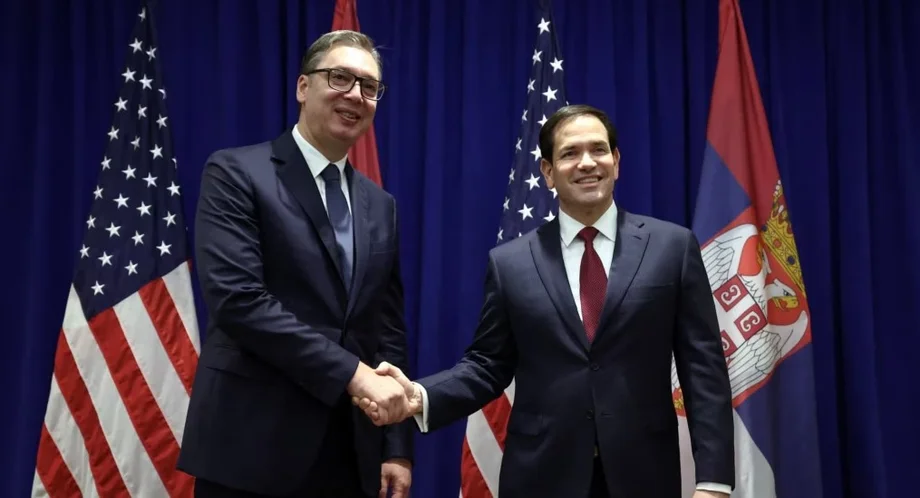
Rubio says Serbia is involved in “potentially problematic and explosive issues”
Serbia is involved in “potentially problematic and explosive issues,” Marco Rubio, the U.S. secretary of state, said in response to journalists’ questions before leaving the United Nations General Assembly in New York on September 23. “It’s clear that Serbia is involved in certain issues that are potentially […]
Serbia is involved in “potentially problematic and explosive issues,” Marco Rubio, the U.S. secretary of state, said in response to journalists’ questions before leaving the United Nations General Assembly in New York on September 23.
“It’s clear that Serbia is involved in certain issues that are potentially problematic and explosive and that attract international attention,” Rubio said, without explaining in detail which issues he was referring to.
He added that, regarding U.S. relations with Serbia, Washington has a strategic partnership with it that it wants to deepen.
“We intend to do that while also addressing potential problems that may arise, which I know are deeply important to them as well,” Rubio said.
He also said that officials from the U.S. State Department and other government agencies have already visited Serbia.
“I hope I will also have the opportunity to visit it,” Rubio said.
In July, the United States and Serbia signed a Memorandum of Understanding on energy infrastructure and regional energy security, as part of the strategic dialogue process held in Washington.
The meeting between U.S. and Serbian officials was opened by Rubio himself.
In August, Republican and Democratic members of the U.S. House of Representatives introduced a bill calling on the United States to take measures against Serbia over its “serious backsliding” in democracy and the rule of law, as well as its cooperation with Russia, China and Iran.
According to the bill, Serbia has experienced serious backsliding in democracy, as reflected in the 2024 Human Rights Report and the European Parliament’s 2025 Report on Serbia, which cite significant problems with the rule of law, judicial independence, media freedom and corruption.
Although it is a candidate for membership in the European Union, Serbia has not opened any new negotiation chapters for nearly five years, among other reasons because of insufficient progress in the rule of law, but also because its foreign policy does not align with that of the EU.
Two months after the last chapter was opened, Russia launched its full-scale invasion of Ukraine, while Serbia did not align its foreign policy with the European Union and did not impose sanctions on Russia.
This was then the main reason for the stagnation of accession negotiations, while, in the meantime, the rule-of-law situation has worsened.
Recently, U.S. Congressman Joe Wilson also proposed moving the annual meeting of the OSCE Parliamentary Assembly from Serbia to South Carolina, explaining that the main reason for this proposal was the “excessive influence” of Russian President Vladimir Putin in Serbia.
In recent years, official Belgrade has also maintained friendly relations with Iran, despite the country being under international sanctions because of its nuclear activities and human rights violations.
Serbian Minister of Information and Telecommunications Boris Bratina was among the few European representatives at the funeral of Iran’s Supreme Leader, Ayatollah Ali Khamenei, in July./REL














