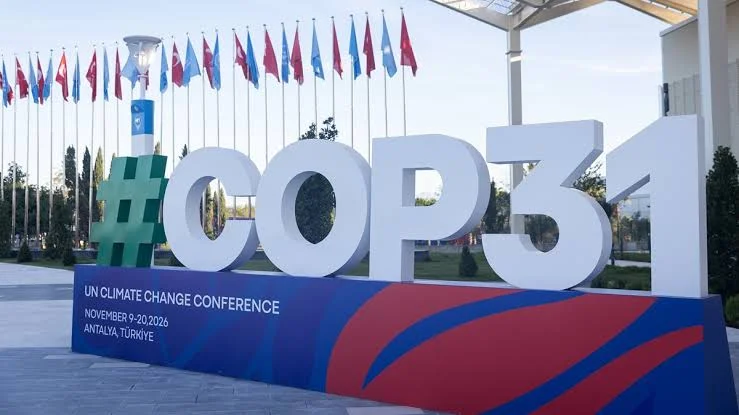
Climate summit extended by two days as countries still fail to agree on a deal
Negotiations at the UN climate summit, COP31, in Antalya, Türkiye, continued on Sunday for a second day beyond the deadline, as countries failed to reach agreement on a common text on climate action.
A new draft agreement was published in the early hours of Sunday, with co-hosts Türkiye and Australia aiming to bridge differences between countries and reach a compromise on the remaining issues.
However, the new text makes no direct reference to “transitioning away from fossil fuels”, an issue that had triggered objections and threats to walk out of negotiations over earlier drafts, BBC reports.
The new draft mentions the commitment made by countries three years ago to transition away from fossil fuels, but does not set out concrete steps for implementing it.
For the first time, the text also acknowledges that the world is on course to miss the target of limiting the rise in global temperatures to 1.5 degrees Celsius, set under the Paris Agreement.
Summit president Murat Kurum, Türkiye’s Environment Minister, has expressed optimism that an agreement can be reached.
“We will be very happy very soon,” he told the BBC as he entered the summit on Sunday.
However, his optimism is not shared by the European Union, which, according to the BBC, considers the new text a step backwards in climate negotiations. The EU and Pacific states had objected to removing references to fossil fuels from the draft agreement.
Meanwhile, countries in the Africa Group are expected to remain dissatisfied with the latest draft, as it contains no specific amount for funding adaptation to climate change, instead postponing that decision to future meetings.
The meeting of countries, scheduled to take place at 09:00 local time, has been postponed again, as negotiations near the longest duration in the history of COP summits.
If countries fail to reach consensus, as required by the UN negotiating process, talks could be suspended until next year. Such a situation has occurred only once since climate summits began in 1995.
EU Climate Commissioner Wopke Hoekstra has warned that if the agreement does not contain the necessary measures for climate action, the bloc will not support it.
“If we cannot get what is needed in terms of climate action... then there is no deal,” he said.
On the other hand, British Energy Secretary Miatta Fahnbulleh, who is leading negotiations for the United Kingdom, has expressed greater optimism, saying her team is continuing to work towards reaching an agreement.
The draft published earlier in the week called for accelerating the transition away from fossil fuels, while the second version, published on Thursday, removed all references to coal, oil and gas, prompting threats to boycott the negotiations.
Due to disagreements, the summit in Antalya has gone past its original deadline of Friday. On Saturday, delegations that had planned to travel on Sunday morning began changing their flights, signalling that an agreement was still not close and that there was a risk of losing the quorum needed to approve it if delegations left.
In a final effort to reach a compromise, the European Union and Saudi Arabia, which hold opposing positions on the future of fossil fuels, sat down for talks on Saturday to find a solution.
Türkiye’s Environment Minister and COP31 president, Murat Kurum, told delegates that he believes the third version of the text addresses the parties’ concerns.
“We ask you to consider this decision carefully,” Kurum told delegates. “We are closer than ever to an agreement on the remaining issues.”
Fossil fuels, a red line for some countries
Panama, the Solomon Islands, Côte d’Ivoire and the European Union have called for the commitment to transition away from fossil fuels to be reinstated in the final agreement, after producers of these resources, led by Saudi Arabia, had called for its removal.
Panama’s Environment Minister, Juan Carlos Navarro, said it was unacceptable for a climate agreement not to mention fossil fuels at all.
Tuvalu’s Climate Minister, Maina Talia, has also described the issue as a red line for his country, stressing that fossil fuels are the main cause of the climate crisis.
French Minister for Ecological Transition Monique Barbut has also criticised references in earlier drafts to carbon capture, utilisation and storage (CCUS), a technology that captures emissions and stores them underground. She said this could serve as an excuse for countries to continue using oil and gas.
In the latest draft, references to this technology have been reduced, which could help ease the EU’s objections.
Funding for developing countries remains unresolved
One of the main issues raised by developing countries, funding to address climate change, remains unresolved.
Earlier versions of the draft included a commitment to increase climate adaptation funding to $120 billion by 2035, but this amount has been removed from the latest text.
Ghana’s Environment Minister and chair of the African Group of Negotiators, Zanetor Agyeman Rawlings, has criticised the lack of funding, saying African countries did not come to the summit to beg for alms, but to demand what is owed to their people, who are facing the consequences of the activities of developed countries.
Meanwhile, activists and environmental organisations, who participate in the negotiations as observers, have strongly criticised the process. Mohamed Adow of the organisation Powershift Africa has described this summit as the worst ever held.
If consensus is not reached, negotiations could be suspended, leaving the countries participating in COP31 without a new global climate agreement.