The Monologue at the UN: Why Kosovo Cannot Respond to Serbia’s Accusations
At the United Nations, a paradox that rarely receives attention is that a member can use the podium of the General Assembly to make any accusations against Kosovo, while the latter does not enjoy the right to respond. Such an asymmetry became visible once again on September 23, when then […]
At the United Nations, a paradox that rarely receives attention is that a member can use the podium of the General Assembly to make any accusations against Kosovo, while the latter does not enjoy the right to respond.
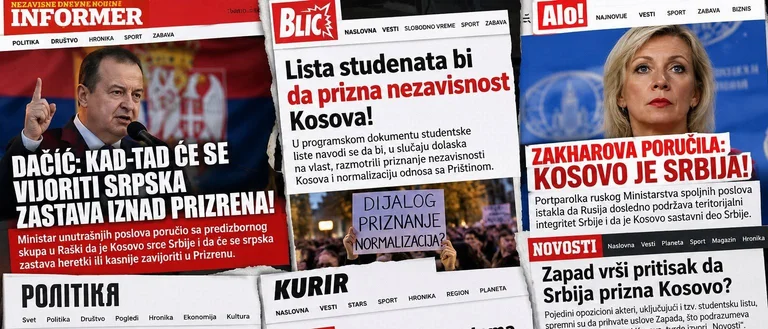
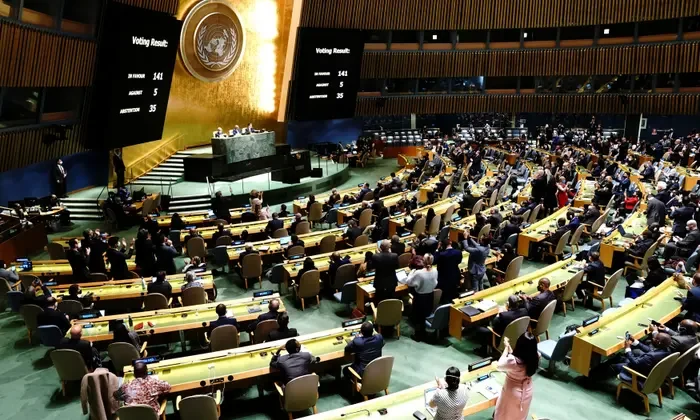
Such an asymmetry became visible once again on September 23, when then-former Serbian President Aleksandar Vučić devoted a lengthy part of his speech at the 81st session of the General Assembly to Kosovo, accusing the states that have recognized Kosovo’s independence of violating the UN Charter and international law, and then threatening that Serbia would defend its territorial integrity, the Charter and Resolution 1244. His accusations went so far as to accuse Kosovo of “ethnic cleansing” against Serbs.
As a UN member state, Serbia has the right to speak and express its positions, but the problem is not this right. The problem is the institutional framework within which it is articulated, where the party being discussed does not have the right or equivalent status to respond to the accusations in the same hall.
This issue goes beyond symbolism.
In 2010, the International Court of Justice, the UN’s principal judicial organ, answered a question submitted through the General Assembly following Serbia’s initiative.
The question was: “Is the unilateral declaration of independence by the Provisional Institutions of Self-Government of Kosovo in accordance with international law?”
The ICJ answered that international law had not been violated, nor had the UN Charter, Resolution 1244 or UNMIK’s Constitutional Framework been violated.
The ICJ’s response to Serbia’s initiative makes the current debate paradoxical: only Serbia is allowed to present its version of international law at the UN and entirely reject the ICJ’s answer, while Kosovo cannot defend itself and challenge interpretations from the same procedural position.
The problem is not only membership
The General Assembly links the right of reply for delegations to special status allowing them to participate in its proceedings. Rule 73 states that the President of the Assembly may grant a member the right of reply. But, since Kosovo is not yet a UN member and does not have any special observer status in the General Assembly, it does not automatically enjoy this mechanism.
However, there are precedents from the past when the General Assembly granted special participation rights to various delegations, including the right of reply. This does not resolve the issue of membership, but it creates a mechanism that enables a non-member party to participate more substantively in debates that directly affect it.
The paradox grows even greater when Kosovo, although it is not recognized by countries such as China, India or Spain, conducts regular trade with them and is part of the international system for the movement of goods, payments and customs procedures. China alone accounts for more than one-tenth of Kosovo’s imports. Thus, political non-recognition has not prevented economic and legal interaction in practice; nevertheless, at the UN, political status continues to deny Kosovo even the opportunity to respond to accusations made against it.
Kosovo’s membership remains a hostage to political issues arising from Russia and China’s vetoes in the UN Security Council, rather than international law criteria. This issue therefore rightly raises the need for reform of the organization.
A test for UN reform
In his speech to the UN General Assembly, Turkish President Recep Tayyip Erdoğan called for reform of the United Nations, arguing that the institution is failing to fulfill the mission for which it was created. Such a debate is not entirely new, but it has been developed more in academic circles than in political ones.
The debate on UN reform usually focuses on the veto, the composition of the Security Council and the representation of emerging powers. The veto issue is where Russia objects most strongly; it is also Kosovo’s main opponent in its bid for UN membership, and once again, this time, it made statements against Kosovo regarding the UN Charter and Resolution 1244 that contradict the ICJ’s finding.
As part of this call for reform, a fundamental procedural problem should also be added: who has the right to speak when they are the direct subject of a debate or a state’s speech.
Such a reform would not require membership status and the right to be heard to be treated as the same issue. On the contrary, the UN could establish a procedural standard under which any party that becomes the direct subject of accusations in the General Assembly has the opportunity to respond, regardless of whether it enjoys full member status. This would separate the issue of political status from the basic need for a fair institutional debate.
At the same time, reform should not sidestep the membership problem. When a state’s admission depends on a Security Council recommendation, the permanent powers’ veto can turn an issue of international representation into a hostage of geopolitical rivalries. Kosovo’s case shows that the consequences of this deadlock are not limited to the absence of a seat at the UN, but also affect its ability to participate in the debate where it is discussed directly.
Therefore, reform should proceed on two parallel tracks: review how political deadlocks affect the membership process and, until then, establish a clear procedural right of reply. This would turn the issue from a privilege of status into a standard of institutional justice.